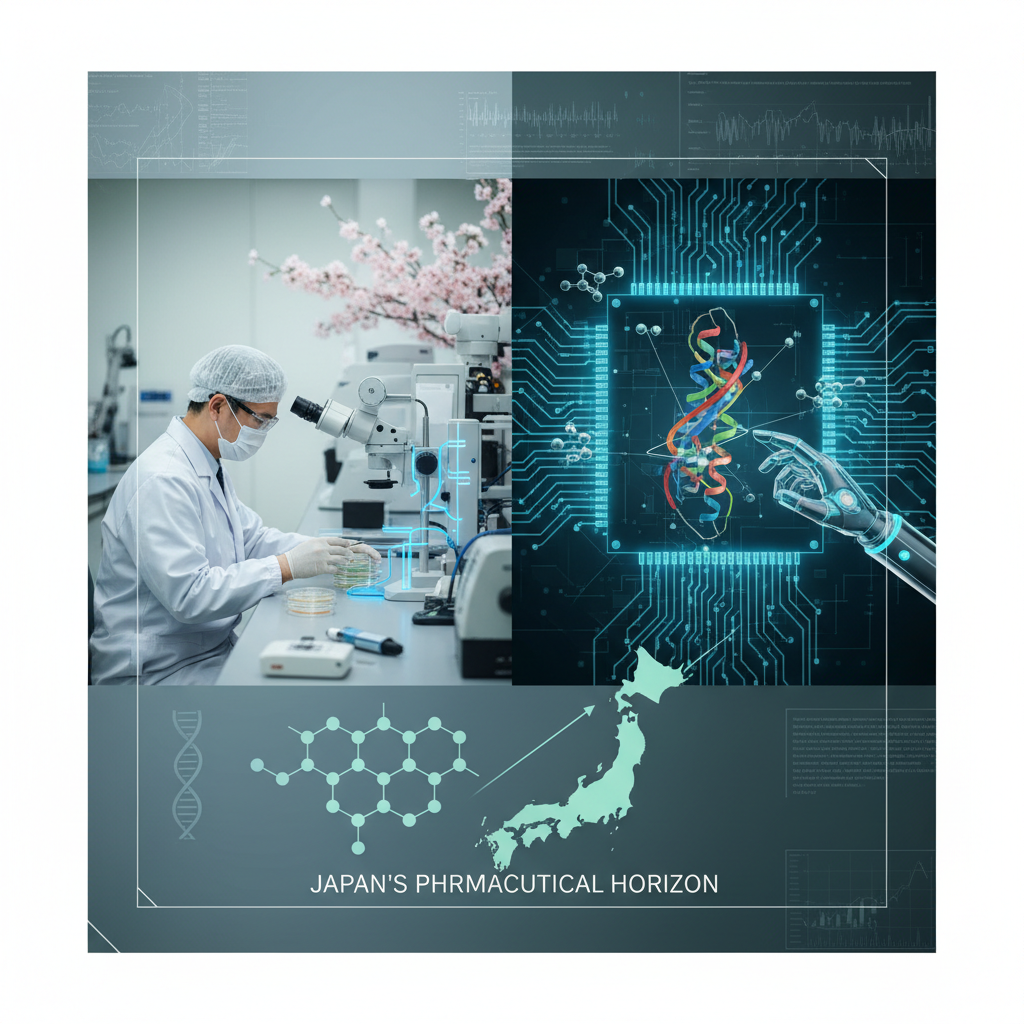

For centuries, the quest for new medicines has been a painstaking journey, a meticulous process akin to a master craftsman in Kyoto selecting the perfect piece of wood, each cut and polish taking years to reveal its true potential. In the pharmaceutical world, this translates to billions of dollars and an average of 10 to 15 years from initial discovery to market. However, a recent development from Google DeepMind and Isomorphic Labs, the unveiling of AlphaFold 3, promises to compress this timeline dramatically, potentially reducing it from years to mere months. This is not merely an incremental improvement, it is a paradigm shift, a digital revolution in the very fabric of drug development.
The breakthrough lies in AlphaFold 3's unprecedented ability to predict the structure of biological molecules, including proteins, DNA, RNA, and ligands, and crucially, how they interact. Previous iterations, notably AlphaFold 2, revolutionized protein folding prediction, a challenge that had stumped scientists for decades. AlphaFold 3 expands this capability, offering a holistic view of the molecular dance that underpins life and disease. Imagine trying to understand a complex traditional Japanese tea ceremony by only observing the tea bowl, without knowing the movements of the host, the guest, or the precise placement of each utensil. AlphaFold 3 now allows us to see the entire ceremony, predicting every interaction with remarkable accuracy.
Why does this matter so profoundly? Precision matters, especially in medicine. The efficacy of a drug often hinges on its ability to bind specifically and effectively to its target molecule within the body. If a drug binds imperfectly, it might be ineffective, or worse, cause harmful side effects. Traditionally, scientists would spend years in laboratories, performing countless experiments to determine these structures and interactions, a process both resource-intensive and often fraught with failure. AlphaFold 3, by providing highly accurate predictions, can drastically narrow down the candidates for experimental validation, accelerating the identification of promising new drug compounds.
The technical details behind AlphaFold 3 are, as one might expect from DeepMind, incredibly sophisticated. At its core, it is a diffusion model, a type of generative artificial intelligence that learns to create complex data by progressively removing noise from a random starting point. This is similar to how an artist might refine a blurry sketch into a detailed painting. The model takes as input the sequences of amino acids for proteins, or nucleotides for Dna/rna, and the chemical structure of ligands, then predicts their three-dimensional structures and how they will interact. It achieves this with what DeepMind reports as a 50 percent improvement in accuracy over existing methods for predicting protein-ligand interactions, a critical metric for drug discovery. The engineering is remarkable, leveraging vast datasets of known biological structures and interactions, and training on immense computational power, largely facilitated by NVIDIA's advanced GPU architectures.
This research, published in the esteemed journal Nature, represents a collaborative effort between Google DeepMind and Isomorphic Labs, the latter being a Google Alphabet company specifically focused on applying AI to drug discovery. The lead researchers, including John Jumper, Demis Hassabis, and Pushmeet Kohli, have been at the forefront of AI innovation for years. Their work builds upon foundational research in structural biology and machine learning, pushing the boundaries of what is computationally possible. Dr. Hassabis, CEO of Google DeepMind and Isomorphic Labs, stated,