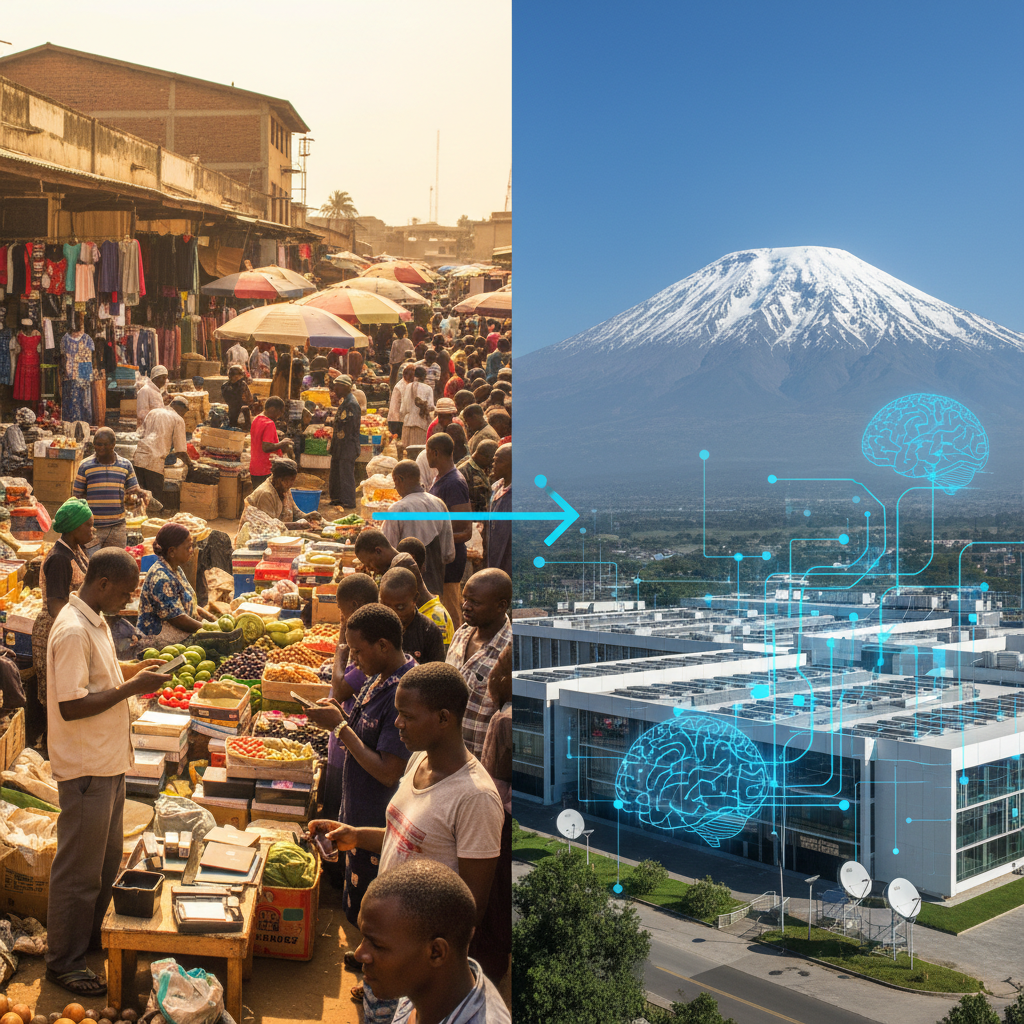

The sun beats down on Kariakoo Market, a symphony of commerce where every transaction is a dance, every price a negotiation. It's chaotic, vibrant, and utterly human. But beneath the surface, something new is stirring, a quiet hum of algorithms and data points that promises to transform how goods move from port to plate, from factory to fashion rack, across Tanzania and beyond. We're talking about AI in retail: demand forecasting, inventory optimization, and personalized shopping. And let me tell you, you can't make this stuff up, because the reality is far more interesting than any marketing brochure.
For too long, the narrative around African tech has been about leapfrogging, about catching up. But what I see, particularly in a market as dynamic and complex as Tanzania's, is an opportunity to innovate differently. Our retail landscape, with its unique blend of formal supermarkets, bustling informal markets, and nascent e-commerce, presents a fascinating challenge for AI. The technical hurdles are immense, but the potential rewards are staggering. This isn't just about making richer companies richer; it's about making supply chains more resilient, reducing waste, and ultimately, serving customers better, whether they're in Dar es Salaam or a remote village near Kilimanjaro.
The Technical Challenge: Predicting the Unpredictable in a Dynamic Market
Imagine trying to predict demand for fresh produce in a country where weather patterns are shifting, infrastructure can be patchy, and consumer preferences are influenced by everything from local festivals to global trends. Traditional statistical models often fall flat. The core problem for AI in retail here is multifaceted: how to accurately forecast demand for thousands of SKUs, optimize inventory across a distributed network with varying lead times, and then personalize offers for customers whose digital footprints might be sparse or inconsistent. It's a data scientist's dream, or nightmare, depending on the day.
Architecture Overview: Building the Brain of Retail Operations
At its heart, an AI-driven retail system needs a robust, scalable architecture. Think of it as a central nervous system for your entire operation. Data ingestion pipelines are critical, pulling in everything from point-of-sale (POS) transactions, sensor data from warehouses, social media sentiment, weather forecasts, and even local news. This data often comes in various formats and quality, demanding sophisticated ETL (Extract, Transform, Load) processes. Cloud platforms like AWS, Google Cloud, or Azure are the usual suspects for hosting, offering scalable compute and storage.
- Data Lake/Warehouse: A centralized repository for raw and processed data. This is where all the disparate data sources converge. Tools like Apache Hudi or Delta Lake on top of object storage (S3, GCS) are common for managing large datasets and ensuring data quality.
- Feature Engineering Pipeline: This component transforms raw data into features suitable for machine learning models. For demand forecasting, features might include historical sales, promotions, holidays, price changes, competitor activity, and macroeconomic indicators. For personalization, it could be browsing history, purchase frequency, demographic data, and product affinities.
- Machine Learning Service Layer: This is where the models live. It's typically composed of microservices, each responsible for a specific task: demand forecasting, inventory optimization, or recommendation engines. Containerization (Docker) and orchestration (Kubernetes) are standard for deployment and scaling.
- API Gateway: Provides a unified interface for other systems (e-commerce platforms, POS, warehouse management) to interact with the AI services.
- Feedback Loop: Crucial for continuous improvement. Model predictions are compared against actual outcomes, and the errors are fed back into the system to retrain and refine models.
Key Algorithms and Approaches: The Magic Behind the Curtain
- Demand Forecasting: This is where the rubber meets the road. For stable products, time-series models like Arima, Prophet, or Exponential Smoothing still have their place. However, for highly volatile or new products, or in environments with sparse data, more advanced techniques are needed.
- Gradient Boosting Machines (GBMs): Algorithms like XGBoost, LightGBM, or CatBoost are powerful for tabular data, handling complex interactions between features. They can capture non-linear relationships and are robust to outliers. For example, predicting sales of kanga (traditional Tanzanian wraps) might involve features like seasonal tourist influx, local fashion trends, and cotton prices, all of which GBMs can model effectively.
- Deep Learning (LSTMs, Transformers): For very long time horizons or when incorporating unstructured data (e.g., product reviews, social media text), recurrent neural networks (RNNs) like LSTMs or even transformer-based models can excel. They can learn complex temporal dependencies. Imagine an Lstm predicting the demand for ugali flour based on past sales, rainfall patterns, and news sentiment about food security.
Conceptual Example for Demand Forecasting (simplified):
 # Input: Historical sales data (time-series), external features (promotions, weather)
 # Output: Forecasted sales for next N periods

 def train_demand_forecast_model(sales_data, external_features):
 # Preprocess data: handle missing values, feature scaling
 X, y = create_features_and_target(sales_data, external_features)

 # Example: Using LightGBM for forecasting
 model = lgb.LGBMRegressor(objective='regression_l1', n_estimators=1000)
 model.fit(X_train, y_train)
 return model

 def predict_demand(model, new_features):
 return model.predict(new_features)
 # Input: Historical sales data (time-series), external features (promotions, weather)
 # Output: Forecasted sales for next N periods

 def train_demand_forecast_model(sales_data, external_features):
 # Preprocess data: handle missing values, feature scaling
 X, y = create_features_and_target(sales_data, external_features)

 # Example: Using LightGBM for forecasting
 model = lgb.LGBMRegressor(objective='regression_l1', n_estimators=1000)
 model.fit(X_train, y_train)
 return model

 def predict_demand(model, new_features):
 return model.predict(new_features)
- Inventory Optimization: Once you know what's likely to sell, you need to ensure it's in the right place at the right time, without holding too much capital in stock. This often involves solving optimization problems.
- Reinforcement Learning (RL): RL agents can learn optimal stocking policies by simulating various scenarios and receiving rewards for meeting demand and penalties for overstocking or stockouts. This is particularly useful for managing perishable goods or items with high holding costs. A local supermarket chain, say Nakumatt, could use RL to decide how many avocados to order daily for each branch, considering spoilage and fluctuating prices.
- Multi-echelon Inventory Optimization: For retailers with multiple warehouses and stores, this approach optimizes inventory levels across the entire supply chain, minimizing costs while maintaining service levels. This is a complex problem often tackled with mixed-integer programming or advanced heuristics.
- Personalized Shopping: This is about making each customer feel seen, understood, and catered to. It moves beyond simple demographic segmentation.
- Collaborative Filtering: Recommending items based on what similar users liked. "People who bought kitenge fabric also bought matching threads."
- Content-Based Filtering: Recommending items similar to those a user has liked in the past. If you bought a certain brand of coffee, it recommends other products from that brand or similar coffee types.
- Hybrid Recommenders: Combining both approaches for better accuracy. Deep learning models, particularly neural collaborative filtering or transformer-based architectures, are becoming standard for handling the vastness and sparsity of e-commerce data. For instance, a local online artisan shop, like Jumia Tanzania Jumia, could use a hybrid model to suggest unique handcrafted jewelry based on a customer's past purchases and the browsing habits of similar customers.
Implementation Considerations: The Real-World Grind
- Data Quality is King: Garbage in, garbage out. This is especially true in emerging markets where data collection might not be standardized. Robust data validation and cleansing pipelines are non-negotiable. I've seen projects falter because they underestimated the sheer messiness of real-world data.
- Scalability: As the business grows, so does the data and the computational demand. Designing for horizontal scalability from day one is crucial. Serverless functions (AWS Lambda, Google Cloud Functions) can be excellent for event-driven processing.
- Model Interpretability: Especially in regulated industries or for critical decisions, understanding why a model made a certain prediction is important. Techniques like Shap (SHapley Additive exPlanations) or Lime (Local Interpretable Model-agnostic Explanations) help shed light on model behavior.
- Offline vs. Online Learning: Many forecasting models can be retrained periodically (offline learning). However, recommendation engines often benefit from real-time updates (online learning) as user preferences shift rapidly.
- Edge Computing: For remote stores with limited connectivity, deploying lightweight inference models at the edge can provide real-time insights without constant cloud communication. This is particularly relevant in parts of Tanzania where internet access can be a luxury.
Benchmarks and Comparisons: How Do We Know It Works?
Measuring success isn't just about fancy algorithms. For demand forecasting, metrics like Mean Absolute Error (MAE), Root Mean Squared Error (rmse), and Weighted Average Percentage Error (wape) are standard. For inventory, it's about reducing stockouts, minimizing overstock, and improving inventory turnover. For personalization, click-through rates (CTR), conversion rates, and average order value (AOV) are key indicators.
Compared to traditional econometric models or simple heuristics, AI models consistently demonstrate superior accuracy, often reducing forecasting errors by 10-30%. Companies like Amazon and Alibaba have been perfecting these techniques for years, but the challenge now is adapting them to local contexts with different data densities and market dynamics. For instance, a small Tanzanian retailer might not have the historical data volume of a global giant, requiring more robust transfer learning or few-shot learning approaches.
Code-Level Insights: Tools of the Trade
Python remains the lingua franca of data science. Key libraries and frameworks include:
- Data Manipulation: Pandas, NumPy
- Machine Learning: Scikit-learn (for traditional ML), XGBoost, LightGBM, CatBoost (for gradient boosting)
- Deep Learning: TensorFlow, PyTorch (for LSTMs, Transformers, neural recommenders)
- Time Series: Statsmodels, Prophet (Facebook's forecasting library)
- MLOps: MLflow, Kubeflow (for managing the ML lifecycle), FastAPI or Flask (for deploying models as APIs)
- Cloud SDKs: Boto3 (AWS), Google Cloud Client Library, Azure SDK for Python.
Real-World Use Cases: Where the Rubber Meets the Road
- Shoprite (South Africa/Regional): While not exclusively Tanzanian, Shoprite, a major player in African retail, has been investing heavily in AI for demand forecasting and supply chain optimization. They use predictive analytics to manage stock across their vast network, reportedly reducing waste and improving product availability, particularly for fresh produce. This directly impacts their bottom line and customer satisfaction.
- Local E-commerce Platforms (e.g., Jumia Tanzania): Jumia, a prominent e-commerce platform across Africa, leverages AI for personalized recommendations, dynamic pricing, and fraud detection. Their recommendation engines, powered by collaborative filtering and deep learning, aim to increase conversion rates by showing users products they are most likely to buy, from electronics to local fashion.
- Wholesale Distributors in Dar es Salaam: Several large distributors, moving goods from the port to smaller retailers, are starting to use AI to optimize their logistics. By forecasting demand from hundreds of small shops, they can optimize delivery routes, warehouse stocking, and even predict potential bottlenecks in the supply chain. This reduces transportation costs and ensures goods reach the market efficiently.
- Agri-tech Startups (e.g., Kilimo Fresh): While not strictly retail, companies like Kilimo Fresh, connecting farmers directly to hotels and restaurants in Tanzania, use predictive analytics to match supply with demand for agricultural produce. This minimizes post-harvest losses, a huge problem in Africa, and ensures fresher produce for consumers. It's a testament to how AI can bridge gaps in fragmented supply chains.
Gotchas and Pitfalls: The Bumps in the Road
- Data Scarcity: Many local businesses lack the rich historical data that global giants possess. This requires creative solutions, such as synthetic data generation, transfer learning from similar domains, or focusing on simpler, interpretable models.
- Infrastructure Limitations: Reliable internet, consistent power, and access to powerful computing resources can be challenges. This often necessitates hybrid cloud solutions or careful optimization of models for lower computational footprints.
- Talent Gap: Finding skilled data scientists and ML engineers locally can be tough. Investment in education and training programs is vital.
- Bias in Data: If historical sales data reflects past biases (e.g., certain regions were underserved), the AI models might perpetuate these. Careful monitoring and fairness metrics are essential.
- Cultural Nuances: Recommendation engines trained on global data might miss local preferences or cultural sensitivities. Fine-tuning models with local data and feedback is critical. What works in New York might not fly in Mwanza.
Resources for Going Deeper: Your Homework Assignment
For those of you looking to dive deeper, I recommend starting with foundational machine learning courses. Then, explore specialized resources:
- Papers: Look into recent publications on demand forecasting and recommendation systems on arXiv. Search for keywords like