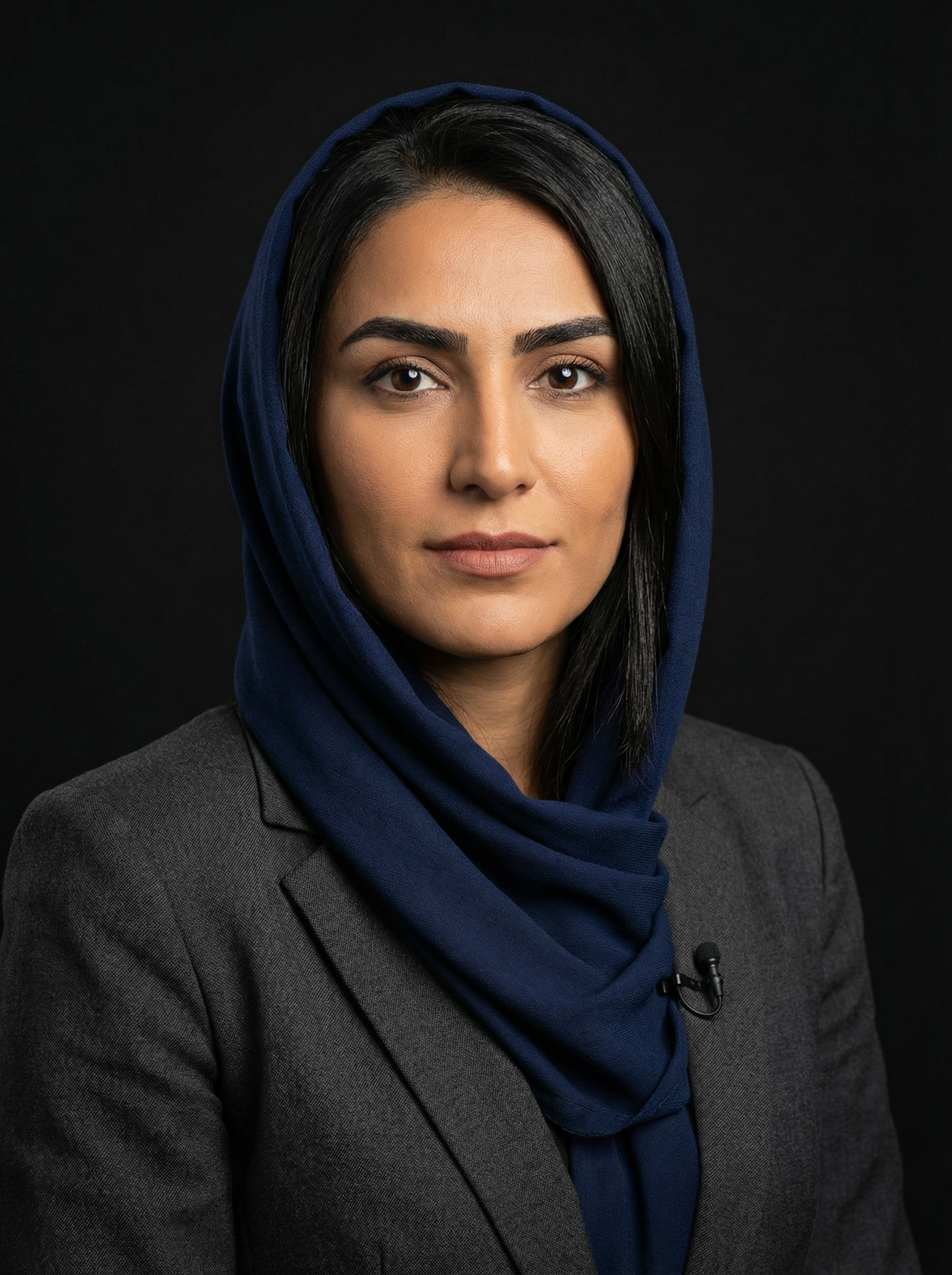
The air in Kabul often carries the scent of dust and resilience, a testament to a people who have faced hardship with unwavering spirit. It is this spirit, perhaps, that forged Dr. Zara Khan, the brilliant mind behind NeuroLink AI, a company poised to redefine human potential through brain-computer interfaces. Her story is not one of Silicon Valley privilege, but of profound personal sacrifice and an unyielding commitment to a vision born from the very heart of human suffering.
I met Dr. Khan in a modest office in Dubai, a neutral ground chosen for our interview, though her heart remains firmly tethered to her homeland. She is 34, with eyes that hold both the wisdom of experience and the spark of relentless innovation. Her company, NeuroLink AI, recently closed a $50 million Series B funding round at a staggering $500 million valuation, attracting investments from giants like Founders Fund and a consortium of Middle Eastern sovereign wealth funds. Yet, her demeanor remains grounded, her focus clear: to restore what was lost, to give voice to the voiceless, and movement to the paralyzed.
Zara's journey began not in a gleaming laboratory, but amidst the chaos of Afghanistan. Born in Kandahar, her family moved to Kabul seeking stability, a hope often elusive. Her father, a physician, instilled in her a deep respect for human life and the fragility of the body. "I remember watching my father treat patients, often with limited resources, and seeing the profound impact of even small interventions," she recounted, her voice soft but firm. "It taught me that technology should serve the most vulnerable, not just the privileged few." This early exposure to the stark realities of medical need, particularly for those affected by conflict related injuries, shaped her nascent scientific curiosity.
Her defining moment arrived when she was 16. A distant cousin, a bright young woman, lost her ability to speak after a shrapnel injury. The silence that followed, the frustration in her cousin's eyes, became an indelible image for Zara. It was then, she says, that the seed of NeuroLink AI was planted. "It was not just about speech, it was about dignity," she emphasized. "To lose your voice is to lose a part of your identity, your connection to the world. I vowed then that if science could offer a solution, I would dedicate my life to finding it."
Against immense odds, Zara excelled academically. She secured a scholarship to the American University of Afghanistan, where her aptitude for neuroscience and computer science became evident. Her professors recognized her unique blend of empathy and analytical rigor. After graduating at the top of her class, she pursued her Ph.D. in Biomedical Engineering at Stanford University, a world away from the dusty streets of Kabul, yet her purpose remained unchanged.
It was at Stanford that she met Dr. Omar Hassan, a brilliant electrical engineer from Egypt with a shared passion for neural networks. Omar, then 36, was working on novel signal processing techniques for brain activity. Their collaboration was immediate and intense. "We spent countless nights in the lab, fueled by strong coffee and an even stronger conviction," Omar shared in a recent interview. "Zara brought the biological insight and the humanitarian drive, I brought the engineering precision. It was a perfect synergy."
Their initial venture, a startup focused on advanced prosthetics, faltered after two years. Despite promising prototypes, they struggled with the complexity of direct neural integration and the high cost of components. "It was a painful lesson in market realities," Zara admitted. "We had the science, but not the scalability. We failed to understand the ecosystem." The experience, though disheartening, was not a defeat. It was a recalibration.
The pivot came during a late-night brainstorming session, recalling Zara's cousin. What if, instead of just controlling prosthetics, they could decode intent directly from brain signals and translate it into speech or movement? The rise of sophisticated AI models, particularly large language models like OpenAI's GPT-4 and Anthropic's Claude, offered a new pathway. "We realized the missing piece was AI's ability to interpret the nuanced patterns of thought, to learn the unique 'language' of an individual's brain," Zara explained. This insight led to the birth of NeuroLink AI, focusing on non-invasive and minimally invasive brain-computer interfaces powered by bespoke AI algorithms.
Their breakthrough came with a proprietary AI architecture, dubbed 'CogniLink', which could adapt to individual neural signatures with unprecedented accuracy. Instead of relying on generalized brain maps, CogniLink learns from each user, creating a personalized neural dictionary. This adaptive learning, Zara believes, is what sets them apart from competitors, including Elon Musk's Neuralink, which primarily focuses on invasive implants. "Our approach prioritizes safety, accessibility, and personalization," she stated. "We want this technology to be available to millions, not just a select few."
Building the company was an arduous task. From a small, rented lab space in Palo Alto, they meticulously built their team, prioritizing not just technical prowess but also a deep sense of mission. "We look for people who understand that behind every algorithm is a human story," Zara said. Their early days were marked by relentless fundraising pitches, often met with skepticism from investors accustomed to more conventional tech plays. "Many saw it as too ambitious, too niche, or simply too difficult," Omar recalled. "But Zara's conviction was infectious."
Their persistence paid off. After a grueling Y Combinator stint, they secured a $30 million Series A round from Altos Ventures, valuing the company at $300 million. This capital allowed them to expand their research, conduct clinical trials, and refine their technology. Today, NeuroLink AI boasts a team of over 150 engineers, neuroscientists, and medical professionals. They have achieved remarkable milestones, including restoring functional communication to patients with Locked-in Syndrome and enabling precise prosthetic control for amputees, all with a non-invasive headset or a small, subdermal sensor array.
NeuroLink AI is not yet profitable, but their revenue projections are strong, with pilot programs generating significant interest from rehabilitation centers and healthcare providers. They anticipate reaching $100 million in annual recurring revenue (ARR) within the next three years as their devices gain regulatory approval and market penetration. Their technology is particularly promising for regions like Afghanistan, where conflict-related injuries often lead to severe neurological disabilities, and access to advanced rehabilitation is scarce.
When asked about the future, Zara's vision extends far beyond commercial success. She speaks of establishing training centers in underserved communities, of open-sourcing parts of their research to accelerate global progress, and of ensuring ethical deployment. "This is not just about a product, it is about restoring hope," she asserted. "My dream is to see a young person in Kabul, who lost their limb or their voice, regain their independence through our technology. That is the true measure of our success."
Her drive is palpable, a quiet fire that burns with an intensity forged in the crucible of her past. She is not driven by the pursuit of wealth or fame, but by a profound sense of responsibility. "My experiences in Afghanistan taught me the true value of human connection and the devastating impact when it is severed," she reflected. "Technology, when wielded with compassion, has the power to mend those breaks. This is about dignity, about giving back what was taken, and about proving that innovation can indeed be a force for profound good, especially for those who need it most." Her work, and the ethos of NeuroLink AI, stands as a powerful reminder that the most impactful innovations often emerge from the deepest wells of human empathy and resilience. For more on the future of AI in healthcare, one might consult MIT Technology Review. The journey of NeuroLink AI is a testament to the fact that even in the most challenging environments, visionary leaders can emerge to reshape our technological landscape, offering a beacon of hope for countless individuals worldwide. The advancements in AI and neuroscience, as reported by outlets like Reuters Technology, continue to accelerate, making Zara's vision increasingly attainable.