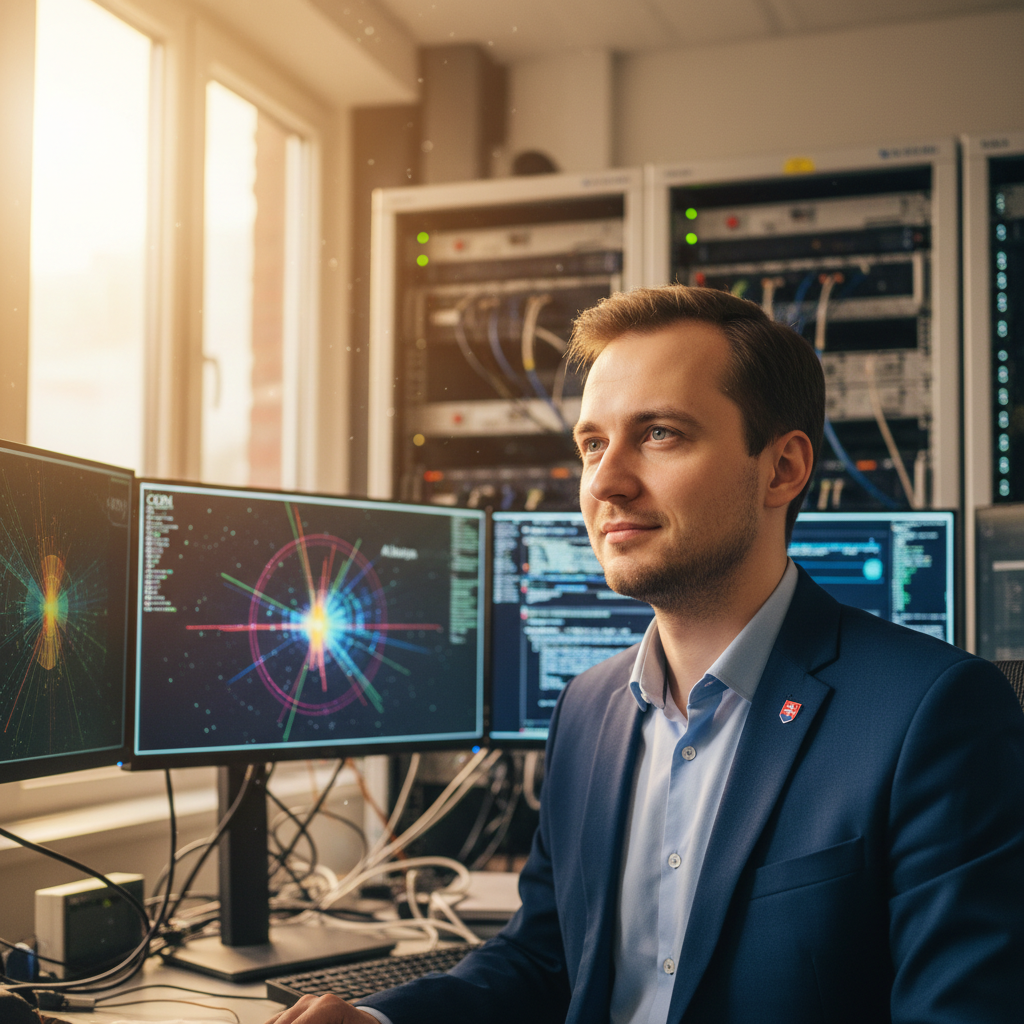

The air crackles with anticipation, a hum of unseen energy. It is not the Large Hadron Collider at Cern, not yet. It is the palpable excitement emanating from Dr. Michal Hrabovský, a physicist whose eyes light up when he talks about the universe, about data, and about the elegant algorithms that can bridge the two. We are in a bustling co-working space in Bratislava, a city that is truly having its moment, and Michal is explaining how his company, Quantum Physics AI, is helping scientists peer deeper into the fabric of reality than ever before. It is a story of ambition, intellect, and a profound belief in the power of technology to reveal the unknown.
Michal's path to the forefront of AI in particle physics is as fascinating as the subatomic particles he studies. He grew up in Košice, eastern Slovakia, a city with a rich industrial heritage and a growing tech scene. From a young age, the mysteries of the cosmos captivated him. Physics was not just a subject in school; it was a calling, a way to understand the fundamental rules governing existence. This early passion led him to pursue theoretical physics at Comenius University in Bratislava, one of Slovakia's most prestigious institutions. It was there that he began to see the immense potential of computational methods to tackle problems that were previously intractable.
After his studies, the lure of the world's most powerful particle accelerator was irresistible. Michal joined Cern, the European Organization for Nuclear Research, a place where the brightest minds converge to push the boundaries of human knowledge. He spent years immersed in the colossal datasets generated by experiments like Atlas and CMS, searching for fleeting evidence of new particles, new forces. It was an environment of unparalleled scientific rigor, but also one where the sheer volume of data posed an immense challenge. Traditional statistical methods, while powerful, were struggling to keep pace with the terabytes, even petabytes, of information streaming from each collision. This was his defining moment, the realization that a new approach was desperately needed.
“The data from Cern experiments is like trying to find a specific grain of sand on every beach on Earth, simultaneously, while they are all shifting,” Michal once told a group of aspiring physicists at a local tech conference. “We needed a magnifying glass, a super-powered one, and that is what AI became for me.” He saw that machine learning, particularly deep learning, could be trained to identify subtle patterns and anomalies in the noise, patterns that human eyes or conventional algorithms might easily miss. This insight was the genesis of Quantum Physics AI.
The idea for Quantum Physics AI did not spring fully formed overnight. It was a gradual evolution, born from countless late nights at Cern, poring over data and collaborating with fellow researchers. One of those collaborators was Dr. Elena Petrova, a brilliant data scientist from Bulgaria, whom Michal met during a joint project on anomaly detection in high-energy physics. Elena brought a deep expertise in neural networks and distributed computing, perfectly complementing Michal's profound understanding of the physics. Their shared vision for leveraging AI to accelerate discovery, combined with their complementary skill sets, made them an unstoppable duo. They realized that their work had implications far beyond their immediate research, that it could be productized and offered to the wider scientific community.
The breakthrough came when they developed a novel neural network architecture specifically optimized for sparse, high-dimensional particle physics data. This architecture, which they later patented, significantly reduced the computational resources required for analysis while improving accuracy. It was a game-changer. Suddenly, analyses that took weeks or months could be completed in days, sometimes even hours. This speedup was not just about efficiency; it meant scientists could explore more hypotheses, refine their models faster, and ultimately, accelerate the pace of discovery. Their initial prototype, tested on publicly available Cern datasets, showed a remarkable improvement in identifying rare decay events, a crucial step in understanding fundamental particles.
Building Quantum Physics AI was not without its challenges. Moving from academic research to a commercial startup required a completely different mindset. Michal and Elena had to learn about business plans, fundraising, and team building. They decided to base their operations in Bratislava, leveraging Slovakia's hidden tech talent and the city's growing startup ecosystem. “We knew we had incredible talent here, people who are passionate about science and technology, and who are often overlooked by the bigger tech hubs,” Michal explained. They initially bootstrapped the company, relying on grants and small angel investments from within the Central European scientific community. Their first major funding round, a seed round of €2 million, came from a consortium of European venture capitalists who saw the immense potential of their technology and the credibility of their scientific backgrounds. This allowed them to expand their team, hiring more physicists, data scientists, and software engineers, many of whom were graduates from Slovak and Czech universities.
Today, Quantum Physics AI is a recognized name in the niche but critical field of scientific AI. Their platform is being utilized by research institutions and universities globally, not just at Cern, but also in astrophysics, materials science, and even medical imaging, where similar challenges of massive, complex datasets exist. The company has grown to over 50 employees, a testament to their vision and execution. They have secured partnerships with several major research facilities, providing their AI tools as a service, and are actively exploring collaborations with quantum computing researchers to further enhance their capabilities. The company's valuation, while not publicly disclosed, is reportedly in the tens of millions of euros, reflecting the specialized, high-impact nature of their work.
What drives Michal Hrabovský? It is not just the pursuit of profit, though a successful business is certainly a goal. It is the sheer thrill of discovery, the idea that his work, and the work of his team, is helping humanity understand the universe a little bit better. “Every time we help a research team confirm a hypothesis or uncover a new phenomenon, it is like a small victory for humanity,” he said, a genuine smile spreading across his face. “That is what gets me out of bed every morning.” He often speaks at universities and high schools across Slovakia, inspiring the next generation of scientists and engineers, emphasizing that groundbreaking innovation can come from anywhere, even from a small country in the heart of Europe.
The future for Quantum Physics AI looks incredibly bright. They are currently developing AI models that can not only analyze data but also help design experiments, suggesting optimal parameters for particle collisions or telescope observations. This could revolutionize the scientific method itself, creating a feedback loop between AI analysis and experimental design. As the world generates ever more scientific data, from cosmic surveys to genomic sequencing, the need for intelligent tools to make sense of it all will only intensify. Dr. Hrabovský and his team are poised to be at the forefront of this revolution, proving that Central Europe's quiet revolution is indeed making a loud impact on the global stage of scientific discovery. Their journey is a powerful reminder that the most profound innovations often emerge at the intersection of deep domain expertise and cutting-edge technology, fueled by an insatiable curiosity about the world around us. You can read more about the broader impact of AI in scientific discovery on sites like MIT Technology Review or Nature Machine Intelligence. The advancements they are making are truly pushing the boundaries of what is possible, and it is thrilling to watch it unfold. The potential for AI to transform scientific research is immense, as explored in many articles on TechCrunch. We are just at the beginning of this incredible journey. {{youtube:5p248yoa3oE}}