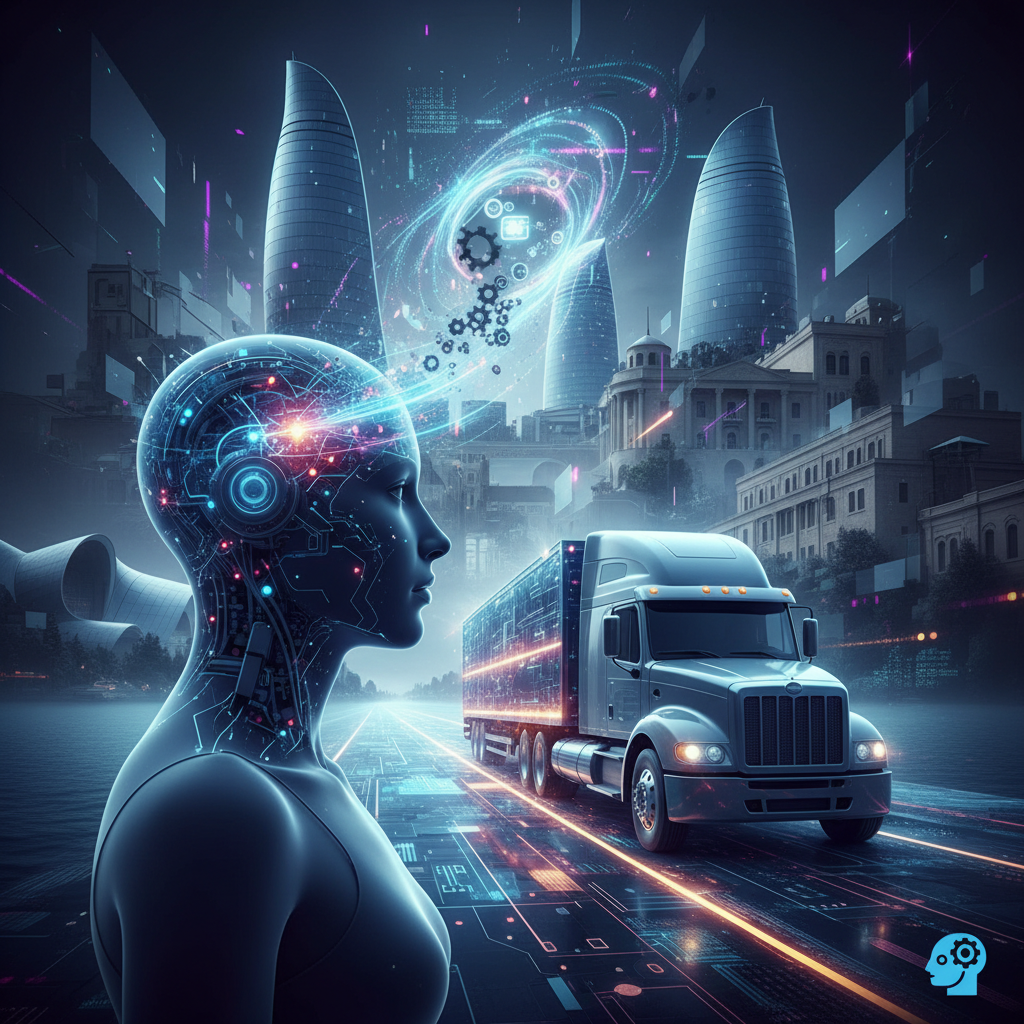

Imagine this: It is a warm morning in Baku, the air is buzzing with the usual energy, and you are sipping your strong Azerbaijani tea. Suddenly, a sleek, futuristic truck glides by, its cabin empty, no driver at the wheel. Just cargo, moving silently, efficiently, powered by invisible algorithms. This is not some far-off sci-fi dream, my friends, this is the very real, very exciting, and sometimes a little bit unsettling future that is already beginning to unfold right here in our beloved Azerbaijan and across the globe.
The $800 billion logistics industry is undergoing a seismic shift, and self-driving trucks and autonomous delivery systems are at the heart of it all. But beyond the impressive technology and the promise of faster, cheaper goods, what does this mean for us, the people? How is this technological marvel impacting our minds, our behaviors, and the very fabric of our relationships?
Let us start with a human scenario, something many of us can relate to. Think about Elchin, a truck driver from Ganja, a city rich in history and known for its vibrant markets. For 20 years, Elchin has navigated the winding roads from Ganja to Baku, his truck a second home. He knows every turn, every tea house along the way, and every shortcut. He has seen the sun rise over the Caspian Sea countless times, delivering everything from fresh produce to construction materials. His job is more than just driving; it is a lifestyle, a community, a source of pride. Now, he hears whispers of autonomous fleets, of companies like Waymo and TuSimple testing their rigs, and a knot forms in his stomach. What will become of him and his fellow drivers? This is not just an economic question, it is a deeply psychological one.
Research findings are already shedding light on these profound shifts. Dr. Leyla Aliyeva, a cognitive psychologist at Baku State University, explains the immediate impact. "We are observing a significant cognitive load shift," she told me during a recent chat. "For consumers, the expectation of instant gratification intensifies. When Amazon or local delivery services like Azerpost promise same-day delivery via autonomous drones or vehicles, our patience wanes for traditional methods. This rewires our perception of time and convenience." She highlighted how the seamlessness of autonomous delivery, while convenient, can also create a psychological distance from the labor involved, making us less aware of the human effort that still underpins much of the supply chain. "It is a double-edged sword," Dr. Aliyeva concluded. "Efficiency at the cost of empathy, perhaps." You can read more about the broader implications of AI on consumer behavior on TechCrunch.
From a behavioral perspective, the introduction of autonomous vehicles brings fascinating changes. Consider the concept of 'trust'. We are inherently wired to trust humans, even if imperfectly. Trusting a machine, especially with something as vital as delivering our goods or sharing the road, is a new frontier. Early studies show a mixed bag. While many are excited by the novelty and efficiency, there is a subconscious anxiety, a need for reassurance. "People often project human-like qualities onto these machines, even when they know intellectually it is just code and sensors," says Dr. Farid Mammadov, a social psychologist specializing in human-AI interaction at ADA University. "This anthropomorphism helps bridge the trust gap initially, but it also means that any malfunction, even minor, can be perceived as a 'betrayal' and severely erode public confidence. We saw this with early incidents involving Tesla's Autopilot, where public perception was heavily swayed by a few high-profile accidents, regardless of the overall safety statistics." This is a critical area for companies like Google's Waymo and NVIDIA, who are investing heavily not just in the technology, but in the public's acceptance of it.
For workers like Elchin, the psychological impact is even more direct. The fear of job displacement is palpable. While many experts argue that new jobs will emerge, perhaps in remote monitoring, maintenance, or data analysis for these autonomous fleets, the transition is far from seamless. The skills required are vastly different. "Imagine being a seasoned driver, your identity tied to your profession, and suddenly being told your expertise is no longer needed in the same way," Elchin confided in me over a cup of tea at a roadside chaykhana. "It is not just about money, Aynurè, it is about dignity, about purpose. My father was a driver, his father too. This is our life." This sentiment is echoed across the logistics sector, creating a significant psychological burden for millions globally. The retraining and upskilling initiatives, while crucial, must also address the emotional and identity shifts involved.
Broader societal implications are equally compelling. The Caucasus is having a moment, and our region, with its strategic location at the crossroads of Europe and Asia, is poised to become a major hub for autonomous logistics. Imagine the impact on trade routes, on the flow of goods from China to Europe, passing right through Azerbaijan. Our cities might see less traffic congestion from long-haul trucks, but perhaps more smaller autonomous delivery bots navigating sidewalks, changing the urban soundscape and pedestrian behavior. The very nature of our public spaces could transform. Will we become more isolated, relying on machines for deliveries, or will it free up human time for more meaningful interactions? These are questions we must grapple with.
Furthermore, the data generated by these autonomous fleets is immense. Every mile driven, every package delivered, every route optimized, creates a digital footprint. This data, managed by giants like Amazon and Microsoft, could offer unprecedented insights into urban planning, consumer habits, and logistical efficiency. But it also raises questions about privacy and surveillance. How comfortable are we with a world where every movement of goods is tracked, analyzed, and potentially predicted? This is a conversation that needs to happen now, not later.
So, what practical advice can we offer as this future unfolds? First, for individuals like Elchin, embracing lifelong learning is paramount. Governments and companies must invest heavily in reskilling programs that are not just technical, but also focus on adaptability and resilience. For consumers, it is about mindful adoption. Enjoy the convenience, but remain aware of the human and ethical considerations behind the technology. Question, engage, and demand transparency from the companies deploying these systems. For policymakers in Azerbaijan, it is about proactive regulation, ensuring that our legal frameworks keep pace with technological advancements, protecting both workers and citizens. The MIT Technology Review often covers these policy challenges.
Azerbaijan is writing its own tech story, one where we can thoughtfully integrate these powerful tools while preserving our values and supporting our people. The journey of autonomous logistics is more than just a technological marvel; it is a profound psychological experiment on a global scale. And this, my friends, is just the beginning.