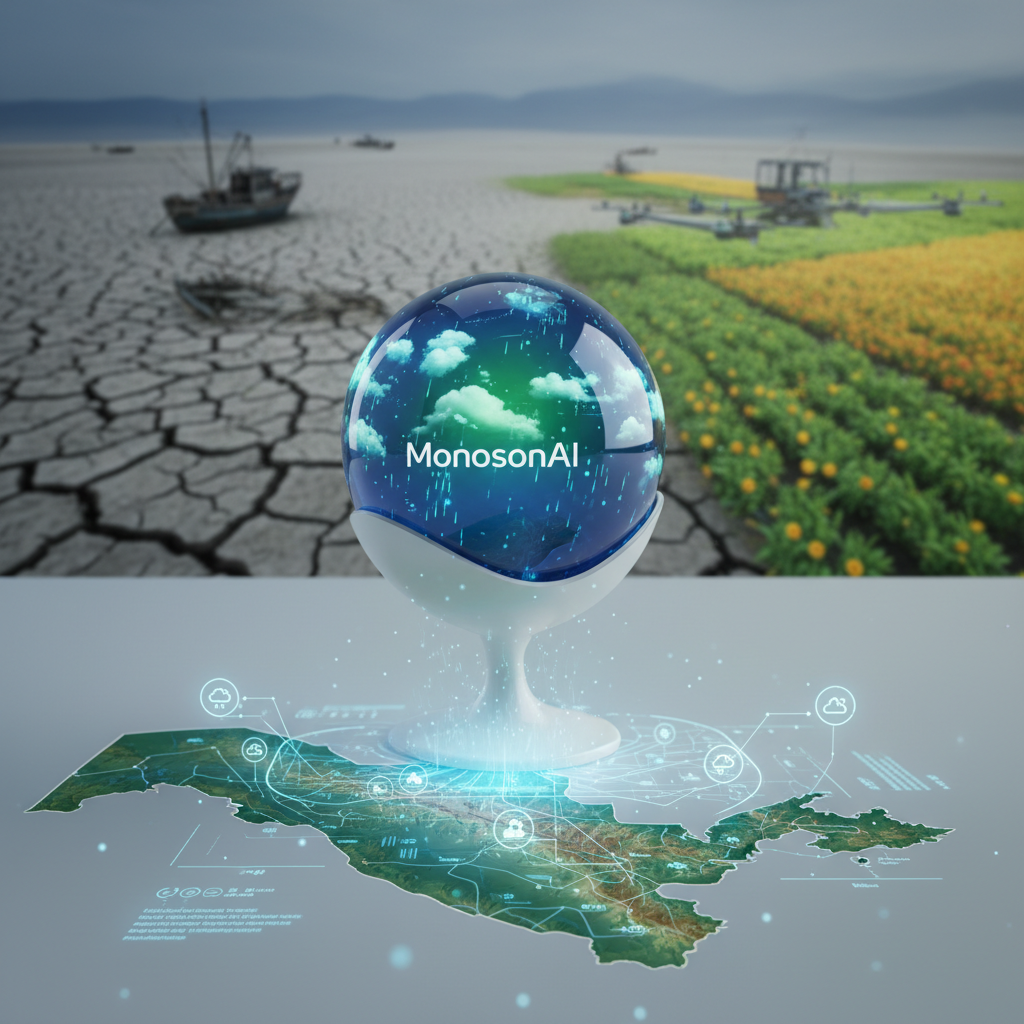

The wind, they say in our villages, has a memory. It remembers the vast, blue expanse of the Aral Sea, now a haunting whisper of its former self. Here in Uzbekistan, the rhythm of life, from the cotton fields of Fergana to the ancient bazaars of Bukhara, has always been dictated by the elements. But the elements are changing, growing fiercer, more unpredictable. Droughts bite deeper, and sudden, violent storms can wipe out a season's harvest in hours. This is why, when I heard about Google DeepMind's new AI platform, 'MonsoonAI,' promising to predict extreme weather with unprecedented accuracy, my journalist's heart, and my Uzbek soul, stirred with a potent mix of skepticism and hope.
I traveled to a small office in Tashkent, not far from the bustling Chorsu Bazaar, where a team of meteorologists and data scientists from the Uzbek Hydrometeorological Service, Uzhydromet, were among the first in Central Asia to pilot MonsoonAI. My first impression was not of flashy graphics or futuristic interfaces, but of quiet determination. The air hummed with the soft whir of servers and the focused tapping of keyboards. This was not a Silicon Valley launch party; this was serious work, grounded in the very real challenges facing our people.
First Impressions: A Glimmer of Clarity in the Haze
MonsoonAI's interface is surprisingly clean, almost minimalist. It presents a map of the region, overlaid with various data points: temperature anomalies, precipitation forecasts, wind patterns, and soil moisture levels. The real magic, however, lies beneath this calm surface. It is powered by a massive neural network trained on decades of global climate data, satellite imagery, and, crucially for us, granular historical weather records from Central Asia. The model claims to offer hyper-local forecasts, down to a 1x1 kilometer resolution, up to ten days in advance, with a claimed 90% accuracy for extreme events. This level of detail, if true, could be a game-changer for our agricultural sector, which accounts for nearly 30% of our GDP and employs a significant portion of our population.
Key Features: Peeking into Tomorrow's Sky
MonsoonAI’s core strength is its predictive capability for extreme weather phenomena. It doesn't just tell you it will rain; it tells you the probability of a sudden, heavy downpour in a specific valley, or the likelihood of a sandstorm sweeping across the Kyzylkum Desert. Key features include:
- Hyper-local Forecasting: As mentioned, the 1x1 km resolution is remarkable. For farmers managing small plots, this is invaluable.
- Early Warning System: Customizable alerts for specific thresholds, like wind speeds exceeding 20 meters per second or rainfall over 50mm in 24 hours.
- Impact Assessment Modules: This is where it gets truly interesting. MonsoonAI can integrate with local agricultural data to estimate potential crop damage from predicted events, allowing for proactive measures.
- Historical Data Analysis: Users can query past weather patterns, helping to identify long-term trends and inform climate adaptation strategies.
- Multi-model Ensemble: It doesn't rely on a single model but combines outputs from various global climate models, a technique known to improve accuracy and reduce uncertainty.
I watched as Dr. Gulnara Karimova, the lead meteorologist at Uzhydromet, navigated the system. She showed me something remarkable: a projection from three days prior that accurately predicted a localized dust storm near Nukus, a region particularly vulnerable to such events.