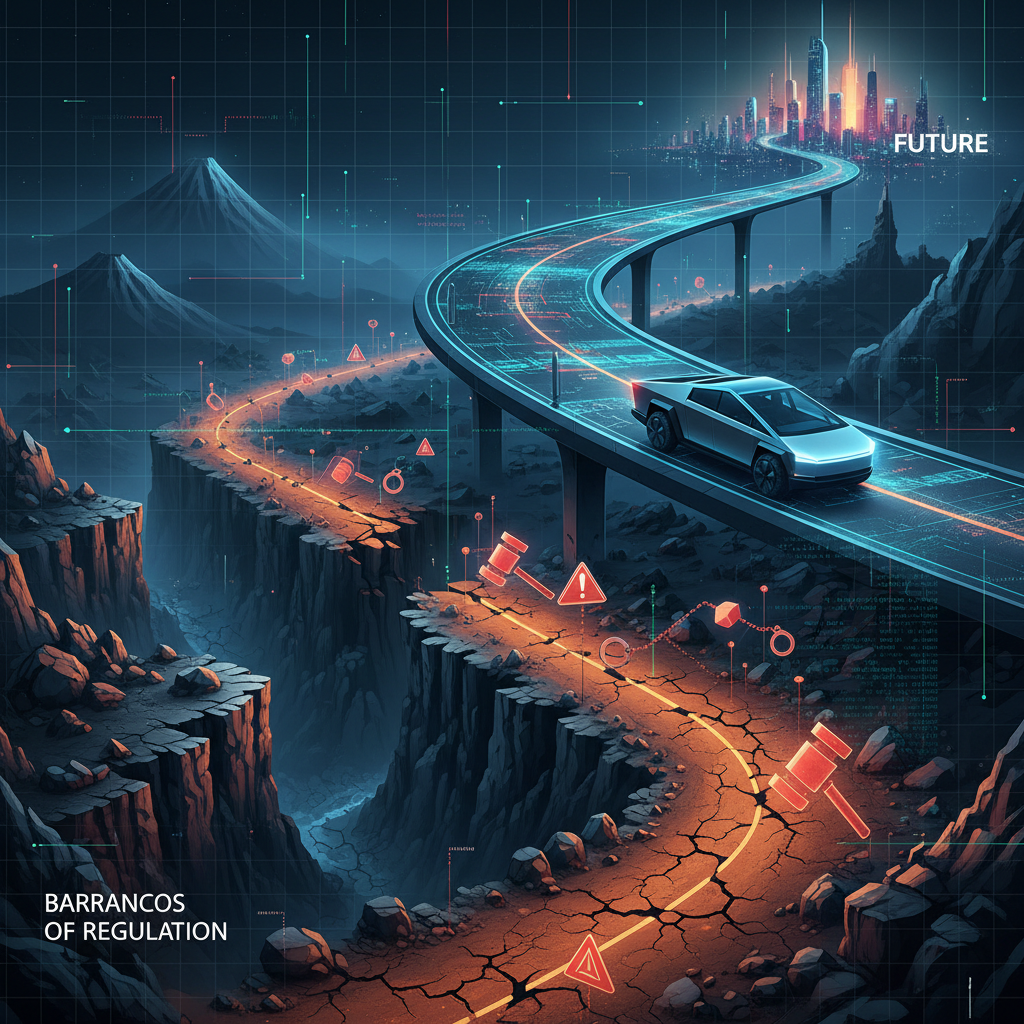
The question hangs in the air like the morning mist over Lake Atitlán: Is Tesla's Full Self-Driving (FSD) technology truly ushering in a new era of transportation, or is it merely a grand experiment caught in a labyrinth of regulatory uncertainty? Here in Guatemala, where our roads tell stories of ancient paths and modern struggles, the idea of a car driving itself feels both miraculous and, perhaps, a little unsettling.
For years, Elon Musk has painted a vivid picture of a future where Tesla vehicles operate as a vast fleet of robotaxis, generating income for their owners and transforming urban mobility. This vision, powered by advanced AI and an ever-growing dataset from millions of Tesla cars on the road, has captivated many. The company's approach, relying heavily on cameras and neural networks to interpret the world, stands in contrast to some competitors who integrate lidar and other sensor modalities. Tesla's FSD Beta program, which has been rolled out to a significant number of owners in North America, allows everyday drivers to test and provide feedback on the system, creating a unique, crowd-sourced development loop.
But the path to this autonomous utopia has been anything but smooth. Each update, each new feature, seems to be met with both fervent praise and sharp criticism. The core of the debate often revolves around safety, liability, and the very definition of 'full self-driving.' Is a system that requires human supervision truly autonomous? This is not just a philosophical question, but a legal and ethical one with profound implications.
Historically, the dream of self-driving cars has been a staple of science fiction for decades. From the automated highways of the 1950s to the intelligent vehicles of the 1980s, the concept has evolved with our technological capabilities. Early attempts at autonomous driving in the 1980s and 90s, often funded by military research, focused on highly structured environments. The real acceleration came with advances in AI, particularly deep learning, and the explosion of computational power in the last two decades. Companies like Google's Waymo, founded in 2009, took a cautious, highly mapped approach, deploying fully autonomous vehicles in geofenced areas. Tesla, entering the fray later, chose a more aggressive, vision-only strategy, aiming for a scalable solution that could operate anywhere.
Today, the landscape is a patchwork of different technologies and regulatory frameworks. While Tesla pushes its FSD system, other players like Waymo and Cruise (General Motors' autonomous vehicle unit) have deployed fully driverless robotaxi services in limited cities, such as Phoenix and San Francisco, albeit with varying degrees of success and public acceptance. Data from these deployments, while promising in some aspects, also highlights the immense complexity of navigating unpredictable urban environments. For instance, Waymo has reported millions of driverless miles with a low incident rate in its operational areas, yet each incident, no matter how minor, draws intense scrutiny. According to Reuters, the autonomous vehicle industry continues to face significant hurdles in scaling operations beyond controlled environments.
Here in Guatemala, the challenges are even more pronounced. Imagine an FSD system navigating the bustling markets of Chichicastenango, where pedestrians, street vendors, and even animals share the narrow, unpaved roads. Or consider the winding, mountainous routes to Nebaj, where landslides can change the road overnight. The infrastructure, the diverse driving behaviors, and the sheer unpredictability of our environment present a formidable test for any AI system trained primarily on North American or European road conditions. The concept of a 'lane' can be fluid, and traffic signs are often suggestions rather than strict rules. This is a story about resilience, not just of technology, but of the communities it seeks to serve.
Expert opinions on Tesla's FSD are as varied as the colors of a traditional huipil. Dr. Missy Cummings, a prominent robotics and human-machine interaction expert and former advisor to the National Highway Traffic Safety Administration, has often expressed skepticism about Tesla's approach. She has publicly stated, "Tesla's Full Self-Driving is not full self-driving, and it's not safe to market it as such." Her concerns center on the system's limitations and the potential for driver overreliance, which can lead to dangerous situations when the system fails to perform as expected.
On the other hand, figures like Andrej Karpathy, a former Director of AI at Tesla, have championed the company's vision-first strategy, arguing that a camera-centric approach is ultimately more scalable and biologically inspired. He believes that with enough data and computational power, neural networks can learn to perceive and navigate the world as effectively as humans, if not better. "The amount of data Tesla is collecting is unparalleled, and that's their secret sauce," Karpathy once noted, highlighting the iterative improvement possible through real-world driving data.
Regulatory bodies globally are grappling with how to classify and govern these nascent technologies. In the United States, the National Highway Traffic Safety Administration (nhtsa) has launched investigations into Tesla's FSD system following several high-profile incidents, raising questions about its safety performance. Meanwhile, European regulators, often more conservative, are developing stringent new standards for autonomous vehicles, emphasizing robust testing and clear liability frameworks. The United Nations Economic Commission for Europe (unece) has also been instrumental in developing international regulations for automated driving systems, pushing for a harmonized approach.
For countries like Guatemala, the regulatory battle feels distant, yet its outcome will profoundly impact future adoption. Our local transit authorities, already stretched thin managing existing infrastructure and traffic challenges, would face an immense task in evaluating and integrating such advanced systems. The legal frameworks for liability in accidents involving autonomous vehicles are still largely undefined, creating a legal vacuum that deters widespread deployment. We are not just talking about technology, but about trust, responsibility, and the fabric of our society. MIT Technology Review often covers the global implications of these regulatory debates, noting how they shape innovation.
So, is Tesla's Full Self-Driving a fad or the new normal? It is likely neither in its current form, but rather a powerful, disruptive force still very much in its adolescence. The ambition is real, the technological progress is undeniable, but the journey to truly autonomous, universally accepted transportation is far from over. The data, the regulations, and most importantly, public trust, are still being written. While the dream of robotaxis navigating the bustling streets of Guatemala City might seem like a distant future, the conversations happening now, in boardrooms and legislative halls across the globe, will determine how quickly, and how safely, that future arrives. The lessons learned from Tesla's journey are not just for Silicon Valley, but for every corner of our interconnected world, including our own. The indigenous communities here, with their deep understanding of their surroundings, remind us that true innovation must always be rooted in context and respect for the human element. Her grandmother's wisdom meets machine learning, indeed, but only if the machine truly understands the wisdom of the road.
For more on the broader implications of AI in transportation, you might find this article on AI agents explained [blocked] insightful, as it delves into the underlying principles of autonomous systems.