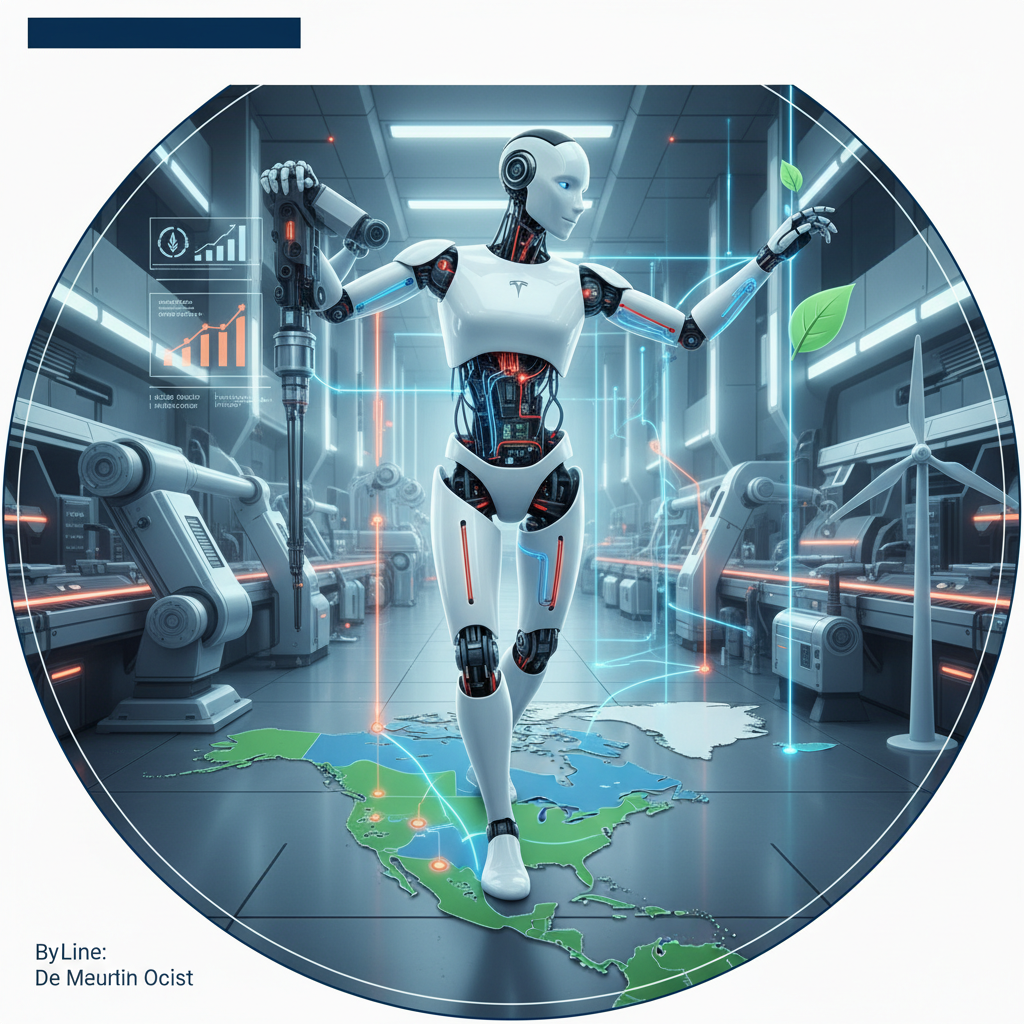

From the sprawling factories of Fremont to the buzzing innovation hubs of Montreal, the conversation around Tesla's Optimus humanoid robot has been, shall we say, lively. Elon Musk, never one to shy away from grand pronouncements, has painted a picture of a future where these bipedal automatons perform tasks too dangerous, dull, or dirty for humans. It is a vision that, if realized, could fundamentally alter the landscape of global manufacturing, including right here in Canada.
But let us be honest, the journey from a flashy prototype doing a little jig on stage to a fully autonomous, production-ready workforce is a marathon, not a sprint. The question on everyone's mind, especially those of us watching from the sidelines of Canada's industrial heartland, is whether Optimus is truly ready to move beyond the lab and into the assembly line. And, more importantly, what does this mean for our own manufacturing sector, which has been grappling with labor shortages and the drive for increased efficiency for years?
The Breakthrough in Plain Language: From Show Pony to Workhorse
At its core, the recent buzz around Optimus stems from Tesla's advancements in what they call 'end to end' AI training. Think of it this way: for years, robots were like highly skilled but very literal children. You had to tell them precisely what to do, step by step, for every single task. If you wanted them to pick up a wrench, you had to program the exact trajectory of their arm, the grip pressure, the angle of approach, and so on. It was incredibly painstaking and limited their adaptability.
Now, imagine teaching a child to pick up a toy. You do not give them a line-by-line instruction manual for muscle movements. You show them, they observe, they try, they fail, and eventually, they learn. Tesla is attempting something similar with Optimus. They are using vast amounts of video data, much of it from human demonstrations and even simulations, to train the robot's neural networks to perform complex tasks directly from visual input. This is a significant shift from traditional robotics, which relies heavily on explicit programming and precise environmental mapping. It is like moving from a meticulously choreographed ballet to improvisational street dance, where the robot can adapt to unforeseen circumstances.
This 'neural network based control' allows Optimus to generalize tasks, meaning it can learn to pick up one type of object and then, with minimal retraining, apply that learning to a similar but slightly different object. This is a game changer for manufacturing, where tasks can vary subtly and environments are rarely perfectly static. As Dr. Ken Goldberg, a professor at UC Berkeley known for his work in robotics and automation, recently noted,