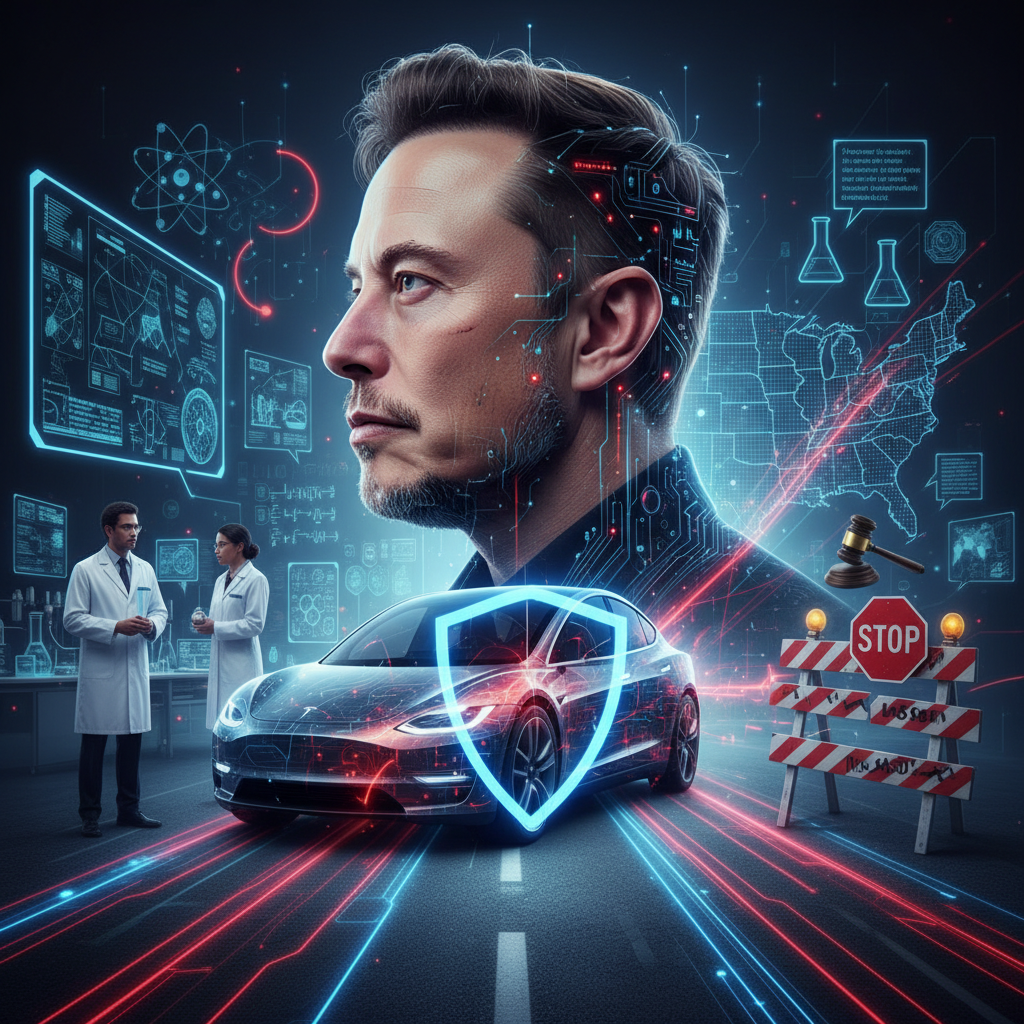
Let's be honest, few topics in tech stir up as much passionate debate as Tesla's Full Self-Driving, or FSD. It is a technological marvel to some, a public safety hazard to others, and a constant headline generator for everyone. For years, Elon Musk has promised full autonomy, a robotaxi future where your car earns you money while you sleep. Yet, here in April 2026, we're still grappling with a system that requires active human supervision, a fact that has put it on a collision course, metaphorically speaking, with regulators across the United States.
But what if the problem isn't just the technology itself, but how we're trying to fit a square peg of AI into the round hole of human-centric traffic laws? That's the core question a new, fascinating paper from the University of Michigan's Transportation Research Institute (umtri) attempts to answer. Titled "Bridging the Perception-Action Gap: An Analysis of Human-AI Discrepancies in Autonomous Driving Regulation," this research, led by Dr. Evelyn Reed and her team, offers a sobering, data-driven look at the regulatory quagmire facing systems like FSD.
The Breakthrough in Plain Language: It's About Expectation Versus Reality
Imagine you're teaching a teenager to drive. You give them rules, they learn to interpret signs, and they develop intuition for other drivers' intentions. Our traffic laws are built on this very human intuition, a shared understanding of how we expect other drivers to behave. Dr. Reed's team argues that current autonomous systems, including FSD, operate on a fundamentally different perception-action loop than humans, and our regulations haven't caught up.
Here's what's actually happening inside OpenAI and other leading AI labs working on autonomous systems. They're building predictive models based on vast datasets of driving scenarios. These models excel at pattern recognition and rapid decision-making within defined parameters. However, human driving involves a complex interplay of social cues, implied intentions, and a nuanced understanding of risk that often goes beyond explicit rules. The Umtri study highlights that FSD's decision-making, while often statistically sound, can diverge from human-expected behavior in edge cases, creating a regulatory blind spot.
"We found that current regulations, particularly at the state level here in the USA, are largely prescriptive, focusing on vehicle safety standards and operational design domains. They don't adequately address the cognitive and behavioral differences between human and AI drivers," explained Dr. Reed during a recent virtual press conference. "It's like trying to regulate a chess grandmaster using the rules for checkers. The games are similar, but the underlying logic is entirely different."
Why It Matters: Safety, Trust, and the Future of Mobility
This isn't just an academic exercise. This research has profound implications for public safety, consumer trust, and the pace of autonomous vehicle deployment. If regulators continue to evaluate AI drivers solely through a human lens, we risk either stifling innovation with overly restrictive rules or, worse, approving systems that operate unpredictably in complex, real-world scenarios. We've seen the headlines, the National Highway Traffic Safety Administration (nhtsa) investigations, and the public outcry when incidents occur. A study published in early 2026 by the Insurance Institute for Highway Safety (iihs) indicated that 78% of US drivers expressed significant distrust in fully autonomous vehicles, a figure that has barely budged in two years. This trust deficit is a direct result of the perceived unpredictability and the regulatory uncertainty.
"The current regulatory patchwork across US states is a nightmare for developers and a source of confusion for the public," stated Sarah Chen, a senior policy analyst at the Department of Transportation, in a recent interview. "Dr. Reed's work provides a crucial framework for understanding where our regulations need to evolve to truly accommodate AI, rather than just forcing it into existing molds. It’s about creating a coherent national strategy, not 50 different ones."
The Technical Details: Unpacking the Discrepancy
The Umtri team utilized a multi-modal approach, combining analysis of publicly available FSD incident reports, simulated driving scenarios, and a novel framework for comparing human driver decision-making protocols with those of advanced AI systems. They specifically focused on scenarios involving ambiguous road markings, unexpected pedestrian behavior, and multi-vehicle interactions at intersections, areas where FSD has historically faced challenges.
One key finding was the concept of "predictive horizon divergence." Human drivers often anticipate events several seconds, or even tens of seconds, into the future, making subtle adjustments based on probabilistic reasoning. FSD, while incredibly fast at reacting, sometimes operates on a shorter, more immediate predictive horizon, leading to decisions that, while technically compliant with rules, might surprise a human driver expecting a different interaction. For example, a human might slow down preemptively for a car that might turn, while FSD might proceed until the turn signal is definitively engaged, a difference that can feel jarring to the human occupant or other drivers.
Furthermore, the study introduced a "Social Expectation Index" (SEI) to quantify the degree to which an AI's driving behavior aligns with typical human social driving norms, not just traffic laws. They found that FSD scored significantly lower on the SEI in complex urban environments compared to human drivers, even when technically obeying all traffic laws. The architecture tells the real story here. While FSD's neural networks are trained on vast amounts of real-world driving data, they are optimized for safety and efficiency within a defined rule set, not necessarily for the unspoken social contract of human driving.
Who Did the Research: Umtri and the Future of Mobility
The University of Michigan's Transportation Research Institute (umtri) has long been a powerhouse in automotive safety and mobility research. Dr. Evelyn Reed, the lead author, is a computational neuroscientist by training, bringing a unique perspective to autonomous systems. Her team included experts in machine learning, cognitive psychology, and transportation policy, creating a truly interdisciplinary approach. Their work was partially funded by a grant from the National Science Foundation (NSF) and supported by anonymized data contributions from several automotive manufacturers and ride-sharing companies, though Tesla was not explicitly named as a direct contributor to this specific dataset.
Their findings were recently published in a special issue of Nature Machine Intelligence dedicated to AI safety and regulation, a significant platform for this kind of impactful research https://www.nature.com/natmachintell/.
Implications and Next Steps: A National Conversation, Not a Patchwork
This research underscores a critical need for a paradigm shift in how we regulate autonomous vehicles. Instead of simply trying to fit AI into existing human-driver regulations, we need to develop a regulatory framework specifically designed for AI's unique capabilities and limitations. This means moving beyond just operational design domains and delving into the cognitive models and predictive behaviors of these systems.
"We need a federal initiative, perhaps led by Nhtsa, to establish a unified national standard for autonomous vehicle behavior and assessment," urged Dr. Reed. "This would provide clarity for innovators like Tesla, consistency for consumers, and, most importantly, a safer path forward for everyone on our roads." This sentiment echoes calls from industry leaders and safety advocates alike, who have long decried the current state-by-state regulatory labyrinth. For more on the broader regulatory landscape, you can often find insightful analyses on MIT Technology Review.
Let me decode this for you: The future of autonomous driving in the USA isn't just about better algorithms or more powerful sensors. It's about a fundamental re-evaluation of the social contract between drivers, whether human or AI, and the rules that govern our shared roads. Tesla's FSD, for all its advancements, is highlighting this tension. The Umtri study provides the data we need to start that crucial conversation, moving from reactive incident analysis to proactive, AI-native regulatory design. Without it, Elon Musk's robotaxi dreams might remain stuck in regulatory traffic, no matter how advanced the software becomes.
The path forward will require unprecedented collaboration between technologists, policymakers, and ethicists. It's a complex problem, certainly more intricate than simply building a self-driving car, but the potential rewards for safety and efficiency are too great to ignore. The question is, are we ready to rewrite the rulebook, or will we continue to force a square peg into a round hole, hoping it eventually fits? The answer will define the future of American mobility.