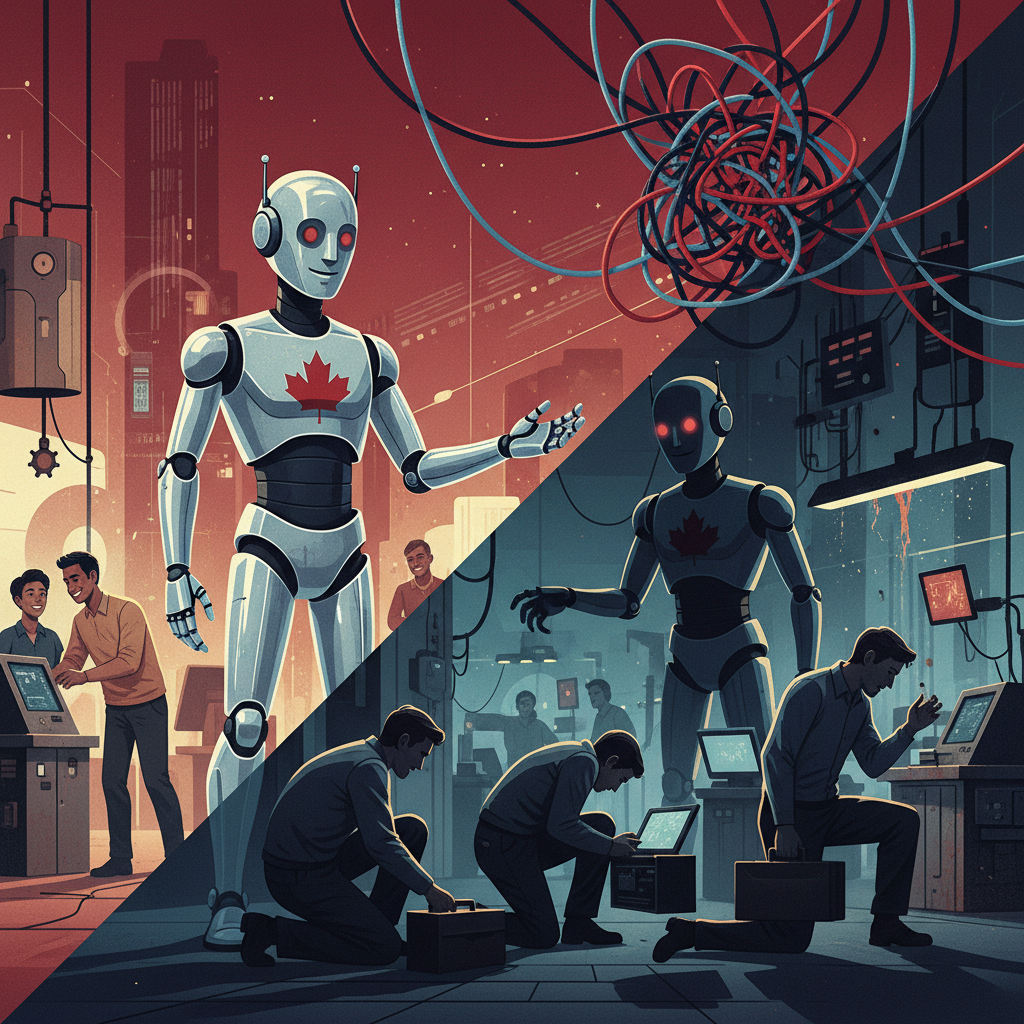

The drumbeat for humanoid robots is growing louder, echoing from the gleaming factories of Silicon Valley to the frosty research labs of Waterloo. We are told these bipedal automatons, capable of mimicking human dexterity and movement, are poised to revolutionize everything from manufacturing floors and distribution centres to elder care in our homes. Yet, as a Canadian journalist accustomed to scrutinizing grand technological pronouncements, I find myself asking a fundamental question: are we truly preparing for a more efficient future, or are we simply inviting a new host of complex societal challenges without adequate foresight?
The narrative is compelling, almost seductive. Companies like Boston Dynamics, Agility Robotics, and even Tesla are showcasing robots that can lift boxes, navigate complex environments, and perform tasks traditionally reserved for humans. The promise is clear: increased productivity, reduced labour costs, and a solution to persistent labour shortages in sectors like logistics and advanced manufacturing. Indeed, the Canadian Chamber of Commerce reported in late 2025 that 43% of Canadian businesses struggled to find skilled labour, a figure often cited as justification for accelerated automation. This context makes the allure of humanoid robots understandable, particularly for industries grappling with an aging workforce and competitive global markets.
However, the enthusiasm often overshadows a critical examination of the practicalities and broader implications. Let's separate the marketing from the reality. While prototypes impress at trade shows, the deployment of these complex machines at scale, particularly in Canada's diverse and often harsh environments, presents formidable obstacles. Consider the operational costs beyond the initial purchase price: specialized maintenance, energy consumption, and the inevitable need for highly skilled technicians to program and troubleshoot these sophisticated systems. This is not merely about replacing a human with a machine; it is about replacing a human with an entire, expensive, and specialized infrastructure.
“The current generation of humanoid robots, while technologically impressive, are still largely laboratory curiosities when it comes to robust, long-term, unsupervised operation in dynamic industrial settings,” states Dr. Anya Sharma, a robotics ethicist at the University of British Columbia. “Their dexterity remains limited compared to a human, and their ability to adapt to unforeseen circumstances, a hallmark of human intelligence, is nascent at best. We are still years, perhaps decades, away from truly autonomous, general-purpose humanoid workers.” Her assessment aligns with data from early pilot programs, which frequently report lower-than-expected return on investment due to unforeseen integration complexities and maintenance demands.
Furthermore, the economic impact on the Canadian workforce demands rigorous analysis. Proponents argue that robots will take on dangerous, repetitive tasks, freeing humans for more creative and fulfilling roles. This is a comforting thought, but the data suggests a different conclusion. A 2024 report by the Brookfield Institute for Innovation + Entrepreneurship projected that up to 1.5 million Canadian jobs, primarily in logistics, retail, and manufacturing, could be significantly impacted by advanced automation within the next decade. While some new jobs will undoubtedly emerge in robot maintenance and AI development, the transition is unlikely to be seamless or equitable. We risk creating a new class of technologically displaced workers, particularly in regions already struggling with economic diversification, such as parts of Atlantic Canada or the resource-dependent communities of the Prairies.
Anticipated counterarguments often revolve around the idea of a 'skills gap' and the necessity for Canada to remain globally competitive. It is argued that if Canada does not embrace this technology, other nations will, leaving our industries behind. While this competitive pressure is real, a reactive adoption strategy without a comprehensive national plan for workforce transition and social safety nets is irresponsible. The Canadian approach deserves more scrutiny, particularly regarding how we intend to manage the human cost of this technological shift. We cannot simply assume that displaced factory workers will seamlessly retrain as AI engineers or robot technicians. The educational infrastructure and accessibility of such retraining programs are currently insufficient to meet the scale of potential disruption.
Consider the social implications of humanoid robots in homes, a prospect often framed as a boon for an aging population. While the idea of a robot assisting with household chores or providing companionship might seem appealing, it raises profound questions about privacy, data security, and the very nature of human connection. Who owns the data collected by these domestic robots? How will we ensure they are not exploited for surveillance or manipulation? The recent privacy breaches involving smart home devices offer a sobering precedent. “The intimate nature of the home environment means that the ethical stakes for domestic humanoid robots are incredibly high,” explains Dr. Marc Tremblay, a legal scholar specializing in AI governance at McGill University. “Without robust regulatory frameworks that prioritize individual autonomy and data protection, we risk creating vulnerabilities that could be deeply damaging to our social fabric.”
Canada, with its strong emphasis on social programs and a history of cautious technological adoption, is uniquely positioned to lead a more balanced conversation. We have institutions like the Canadian Institute for Advanced Research (cifar) and the Vector Institute that are at the forefront of AI research, but their insights must be integrated into policy discussions that extend beyond economic metrics. We need a national strategy that addresses not just the technological deployment, but also the societal consequences. This includes investing significantly in universal basic skills training, exploring innovative social welfare models, and developing robust ethical guidelines for robot design and deployment.
The federal government's recent discussions around an AI and Data Act are a step in the right direction, but they must specifically address the unique challenges posed by embodied AI, not just algorithms. We need clear accountability mechanisms for robot failures, transparent data governance policies, and a public discourse that moves beyond simplistic narratives of progress or peril. The future of work and home life in Canada will undoubtedly involve advanced automation, but the form it takes, and whether it truly benefits all Canadians, depends entirely on the proactive and thoughtful policies we implement today. To ignore the potential downsides, to simply chase the hype, would be a disservice to the pragmatic spirit that defines our nation. The time for critical assessment, not just enthusiastic adoption, is now. For more analysis on the broader implications of AI, readers can refer to MIT Technology Review or Wired. The conversation around AI's impact on employment is also frequently covered by Reuters.
We must ask ourselves: are we building a future where technology serves humanity, or one where humanity merely adapts to the demands of technology? The answer, for Canada, remains to be written, and it requires more than just technological prowess; it demands profound ethical consideration and a commitment to a just transition for all.