For years, we have heard the promises of artificial intelligence, often delivered from distant tech hubs with little understanding of our realities here in Burkina Faso. The narrative usually involves collecting vast amounts of data, sending it to powerful cloud servers overseas, and then receiving some 'intelligent' service in return. But for many, especially in sectors like agriculture and public health, the idea of exporting our most sensitive information, our farmers' crop yields, our patients' medical histories, felt like a Faustian bargain. Who truly benefits when our data leaves our borders? Who controls it then?
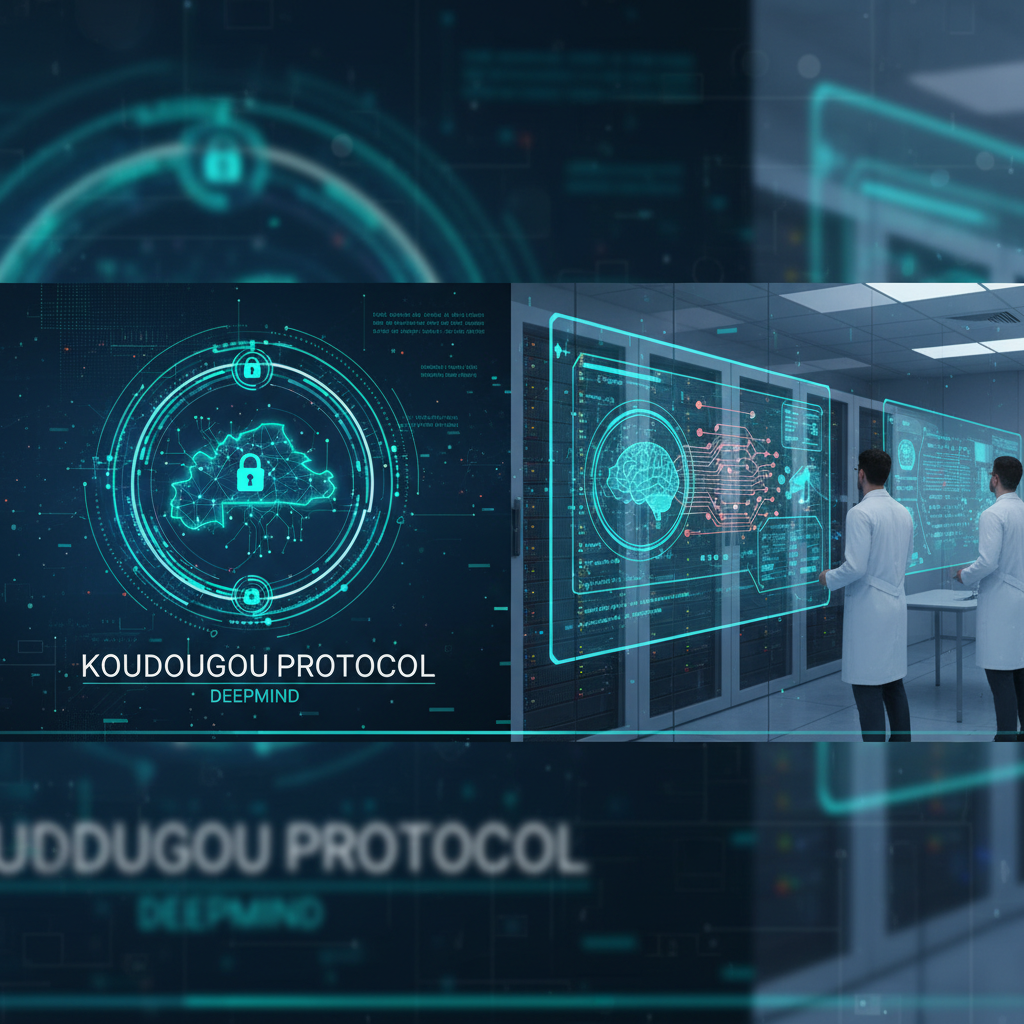
That question has been a persistent drumbeat in my reporting, and it is why a recent development from Google DeepMind, working in collaboration with researchers at the National Institute for Scientific and Technical Research (IRSAT) in Ouagadougou, has caught my attention. They call it the 'Koudougou Protocol,' a federated learning framework designed specifically for low bandwidth, intermittent connectivity environments, and critically, with an emphasis on data sovereignty. This is not just another academic paper; this is a blueprint for a future where AI serves us, without us having to surrender our digital patrimony.
The Breakthrough in Plain Language: Training AI at Home
The core problem federated learning solves is simple: how do you get the benefits of a powerful AI model, trained on a large, diverse dataset, without centralizing all that data in one place? Imagine you have thousands of small health clinics across Burkina Faso, each with patient records. To build an AI that can accurately diagnose a specific disease, you need data from all of them. Traditionally, you would gather all those records, anonymize them as best you could, and send them to a central server for training. This is where privacy risks and data sovereignty concerns arise.
The Koudougou Protocol changes this. Instead of sending the raw data, each clinic's local server trains a small, local version of the AI model using its own data. Once trained, only the updates to that local model, not the data itself, are sent to a central server. The central server then aggregates these updates from all clinics, creating a more robust, global model. This improved global model is then sent back to each clinic, enhancing their local AI without ever seeing a single patient record from another clinic. It is like teaching many students separately, then having them share only their improved understanding, not their personal notes.
Why It Matters: Trust, Sovereignty, and Local Impact
For a country like Burkina Faso, this is revolutionary. "For too long, the narrative has been that we must choose between technological advancement and data privacy," says Dr. Aminata Traoré, Director of IRSAT's AI for Development Lab. "The Koudougou Protocol shows us that we can have both. It builds trust, which is essential for deploying AI in sensitive areas like public health and food security. Our data stays here, on our soil, under our control." This is not a small thing; it is the foundation of digital self-determination.
Consider the agricultural sector. We have diverse farming practices, varying soil types, and localized pest issues. An AI model trained on global data might miss the nuances of a specific village's challenges. With federated learning, local agricultural cooperatives can train models on their specific crop data, soil conditions, and weather patterns. These local models then contribute to a broader, more general model that still respects the privacy of individual farm data. The reality on the ground is that local context is everything, and this protocol respects that.
The Technical Details: Smart Aggregation and Resilience
The Koudougou Protocol, detailed in a recent preprint on arXiv, builds upon existing federated learning techniques but introduces several key innovations. The primary challenge in our context is unreliable network connectivity. Traditional federated learning assumes stable, high-bandwidth connections. The Koudougou Protocol incorporates a robust asynchronous aggregation mechanism, meaning local models can send updates whenever a connection is available, rather than requiring simultaneous communication. This makes it far more practical for rural deployments.
Furthermore, it employs a novel differential privacy technique during the aggregation process. This adds a layer of mathematical noise to the model updates, making it even harder to infer individual data points from the aggregated model. "We are not just protecting data in transit; we are making it mathematically improbable to reconstruct private information from the shared model parameters," explained Dr. David Chen, lead researcher from Google DeepMind, in a virtual press briefing. "This is crucial for earning the trust of communities where data sharing has historically been viewed with skepticism, often for good reason."
Another innovation is its lightweight client-side computation. Many federated learning frameworks require significant processing power at the local nodes. The Koudougou Protocol is optimized for edge devices and low-power servers, making it suitable for deployment in settings where access to high-end computing infrastructure is limited. This means a small clinic or a village agricultural center can participate without needing a server rack full of NVIDIA GPUs.
Who Did the Research: A Collaborative Effort
The project was a true collaboration. While Google DeepMind provided the foundational AI expertise, the practical insights and deployment strategies came directly from Irsat researchers and local community leaders. Dr. Fatoumata Diallo, a data scientist at Irsat, spent months in rural communities, understanding the actual constraints and needs. "It was not about imposing a solution, but co-creating one," she told me during a recent visit to Ouagadougou. "We needed to understand how farmers manage their data, how health workers record patient information, and what their concerns were. That informed every technical decision." This kind of partnership, where global tech meets local knowledge, is essential for meaningful impact.
Implications and Next Steps: A New Model for African AI
The implications of the Koudougou Protocol extend far beyond Burkina Faso. It offers a viable pathway for other African nations to leverage AI without compromising their data sovereignty. Imagine similar systems for managing water resources in the Sahel, where local sensors monitor water levels and quality, training models that predict drought or contamination, all while keeping sensitive infrastructure data decentralized.
Already, pilot programs are underway. In the province of Kadiogo, a federated learning network is being tested with five health clinics to improve early detection of malaria. Initial results, though preliminary, show a 15% improvement in diagnostic accuracy compared to traditional methods, while maintaining strict patient data privacy. "This is not some Silicon Valley fantasy," said Mr. Oumarou Sawadogo, a community health worker participating in the pilot. "This is real, and it is helping us serve our people better, without asking us to give up our dignity or our data." This is what actually happened, and it is a testament to what is possible when technology is designed with local needs at its heart.
Moving forward, the challenge will be scaling this. It requires investment in local infrastructure, training for technical staff, and continued community engagement. But the groundwork has been laid. The Koudougou Protocol provides a powerful example of how AI can be a tool for empowerment, not just a mechanism for data extraction. Forget the hype, this is what matters: building AI that respects our sovereignty, understands our context, and ultimately, serves our people. It is a model that other global tech giants, including perhaps OpenAI or Meta, should pay close attention to if they truly want to make a difference in our part of the world. The future of AI in Africa will not be about taking our data, but about empowering us to use our own. This is a critical step in that direction.