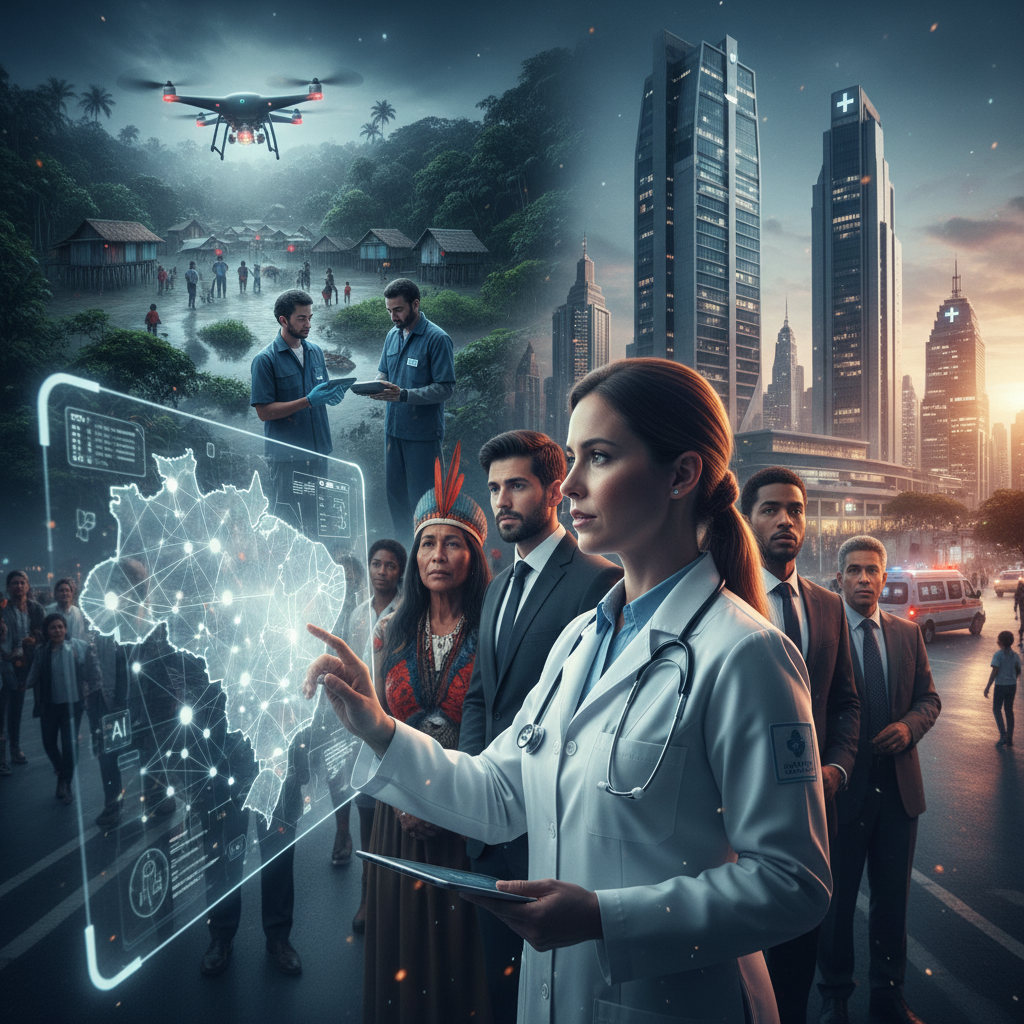
Rio de Janeiro, Brazil, April 2026. The air in Brasília today was thick with anticipation, not just the usual humidity, but something more electric. President Silva, flanked by health ministers and tech innovators, announced what many are calling Brazil's most audacious leap into the future of public health: Projeto Saúde Futura. This isn't just another government program, amigos, this is a full-scale national commitment to integrate artificial intelligence into every facet of our healthcare system, from the bustling emergency rooms of São Paulo to the most remote indigenous communities along the Amazon River. It's a bold move, a jogada de mestre, and one that could fundamentally transform how millions of Brazilians access medical care.
For too long, our healthcare system, despite the incredible dedication of its professionals, has wrestled with immense challenges: vast geographical distances, a chronic shortage of specialists in rural areas, and the ever-present threat of new pandemics. Think of it like a beautiful, powerful car, but one constantly running on three cylinders because the fourth is always struggling to fire. Projeto Saúde Futura aims to fix that misfire, not with a patch, but with a complete engine overhaul powered by AI.
At its core, the initiative focuses on three pillars: AI-driven diagnostics, expanded telemedicine infrastructure, and robust pandemic preparedness. Let me explain the architecture. On the diagnostics front, the government is investing R$4.8 billion, roughly US$950 million, into deploying advanced AI models capable of analyzing medical images, pathology slides, and patient data with unprecedented speed and accuracy. Imagine an AI system, trained on millions of anonymized Brazilian patient records, that can flag early signs of dengue, tuberculosis, or even certain cancers with an accuracy rate reported to be over 92% in initial trials. This is not science fiction, my friends, this is the reality they are building.
“This is a game changer for our public health system, the SUS,” declared Dr. Ana Clara Mendes, Brazil’s Minister of Health, her voice resonating with conviction during the press conference. “We are bringing world-class diagnostics to every corner of our nation. No longer will a patient in a small town have to wait months for a specialist’s review. AI will be their first, vital line of defense.” Minister Mendes highlighted a pilot project in the state of Pará, where AI-assisted diagnosis reduced misdiagnosis rates for neglected tropical diseases by 18% and accelerated treatment initiation by an average of 35 days. These are not small numbers, these are lives saved and improved.
Telemedicine, the second pillar, is set to receive an equally significant boost. Building on lessons learned, sometimes painfully, during the recent global health crisis, Projeto Saúde Futura plans to expand high-speed internet access to over 3,000 previously underserved municipalities, primarily in the North and Northeast regions. This will enable remote consultations, virtual specialist referrals, and continuous patient monitoring. It's like building digital bridges across our vast country, connecting doctors in urban centers with patients who might be days away from the nearest hospital. The goal is to conduct over 50 million AI-assisted telemedicine consultations annually within five years, a truly staggering figure.
“The pandemic showed us the critical need for resilient, accessible healthcare,” stated Professor Ricardo Almeida, a leading epidemiologist from the Oswaldo Cruz Foundation, a renowned biomedical research institution in Brazil. “With AI, we can predict outbreaks with greater precision, allocate resources more effectively, and develop rapid response protocols. This isn’t just about treating illness, it’s about preventing it on a national scale.” Professor Almeida emphasized the importance of data integration, noting that the success of these predictive models hinges on real-time, comprehensive data collection, a challenge Brazil is uniquely positioned to address given its robust public health data infrastructure.
The third pillar, pandemic preparedness, leverages AI for epidemiological surveillance, vaccine distribution logistics, and even drug discovery. The plan includes the establishment of a National AI Health Command Center, a sort of digital nerve center that will monitor health trends, simulate outbreak scenarios, and coordinate responses across states. This center will utilize advanced machine learning algorithms to identify emerging pathogens and predict their spread, giving us a crucial head start. It’s like having a digital sentinela always watching, always learning, always ready to sound the alarm.
Of course, such an ambitious undertaking is not without its challenges. Data privacy, algorithmic bias, and the need for a highly skilled workforce are all critical considerations. The code tells the real story, and the code needs to be ethical, transparent, and robust. The government has announced the creation of a new regulatory body, the Agência Nacional de Inteligência Artificial em Saúde (anais), to oversee the ethical deployment of these technologies and ensure patient data protection. This is a crucial step, as trust is the bedrock upon which any successful digital transformation must be built.
Reactions from the ground have been varied, but largely optimistic. Dr. Eliana Costa, a general practitioner working in a small clinic in the interior of Bahia, expressed cautious enthusiasm. “For years, I’ve had to send patients on arduous journeys just to get a specialized scan. If AI can help me diagnose faster and telemedicine can connect them to specialists without leaving their homes, it will be a miracle for my community,” she told DataGlobal Hub. “But we need proper training, and reliable internet, not just promises.” Her pragmatism is a healthy reminder that technology is only as good as its implementation.
Indeed, Brazil's developer community is massive and talented, and many are already being tapped for this national effort. Universities across the country, from USP to Ufmg, are launching new programs to train AI specialists specifically for healthcare applications. This is not just about importing solutions, but about building our own capacity, fostering local innovation, and ensuring that these tools are tailored to our unique needs and cultural context. For more on how other nations are grappling with AI in healthcare, you might find this article on Mexico's AI health initiatives insightful, as it explores similar challenges and opportunities in Latin America.
The next steps involve a rapid rollout of pilot projects in key regions, followed by a phased national deployment over the next three years. The Ministry of Health is actively seeking partnerships with leading AI companies, both domestic and international, to accelerate development and ensure interoperability. According to a recent report by Reuters Technology, global investment in healthcare AI is projected to reach US$100 billion by 2030, and Brazil is clearly positioning itself to be a significant player in this burgeoning market.
Why should you care about this, beyond the borders of Brazil? Because what happens here, in a nation of over 200 million people with immense geographical and social diversity, could serve as a blueprint for other developing nations. If Brazil can successfully leverage AI to democratize healthcare access and bolster pandemic resilience, it offers a powerful model for global health equity. This isn't just about technology, it's about dignity, access, and the fundamental right to health. It's about ensuring that no matter where you live, from the favela to the fazenda, you have a fighting chance against illness. The world will be watching to see if Projeto Saúde Futura truly delivers on its promise to heal a nation, one algorithm at a time. It’s a gamble, yes, but one that Brazil, and perhaps the world, desperately needs to win.```