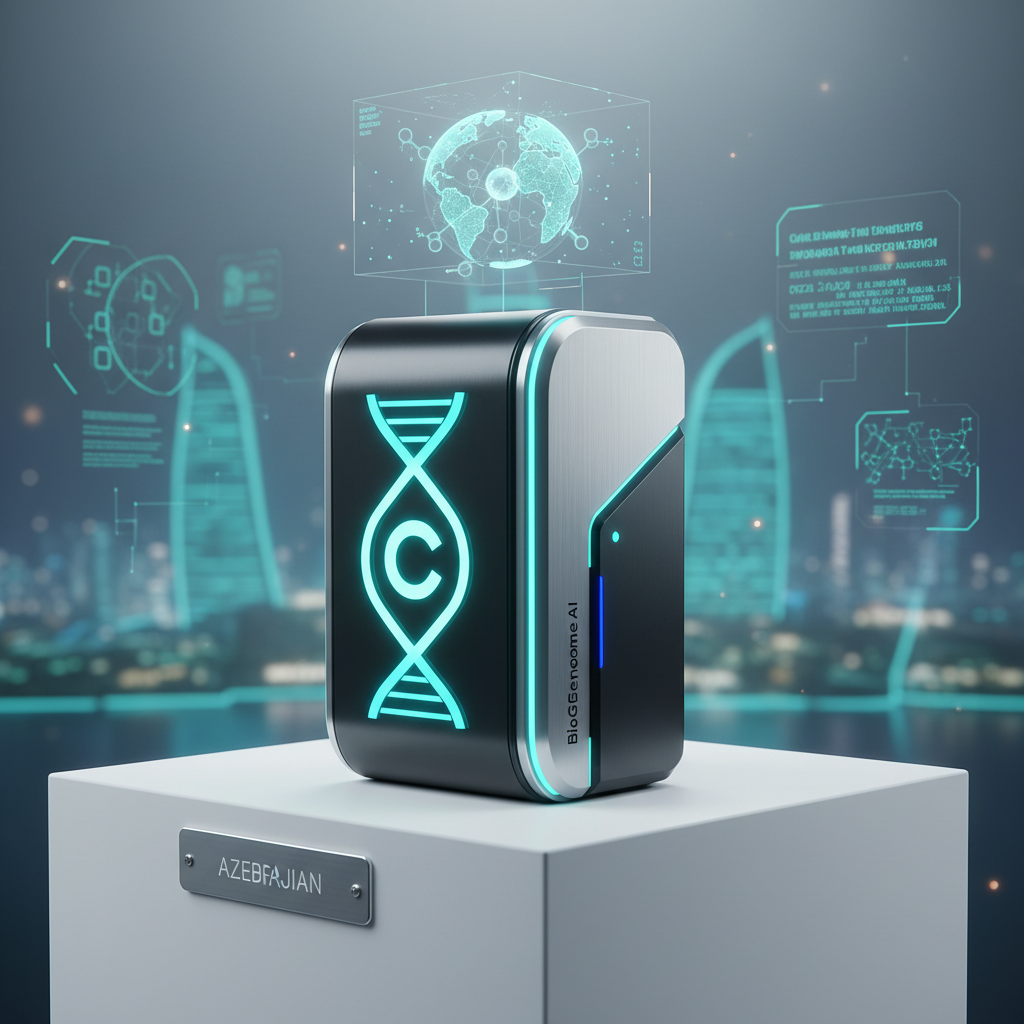

Baku, my vibrant city, is buzzing with an energy that feels almost electric these days. You can practically taste the innovation in the air, a delicious blend of ancient history and cutting-edge tech. We're not just about oil anymore, you know, Azerbaijan is writing its own tech story, and it is a thrilling narrative indeed. Today, I want to talk about something truly groundbreaking, something that makes my journalist heart sing with excitement: BioGenome AI's new Crispr Catalyst platform.
For years, we have heard whispers about CRISPR's potential, the molecular scissors that can edit DNA with incredible precision. But the dream of truly personalized, error-free gene therapy felt like it was always just beyond our grasp, like a beautiful, distant peak in the Caucasus mountains. Well, my friends, BioGenome AI, a homegrown startup right here in Azerbaijan, is bringing that peak into sharp focus. They have married the raw power of Crispr with the intelligent finesse of machine learning, and the result is nothing short of revolutionary.
First Impressions: A Symphony of Data and Design
When I first logged into the Crispr Catalyst platform, I was immediately struck by its intuitive design. As someone who has navigated countless clunky scientific interfaces, this was a breath of fresh air. It felt less like a complex lab instrument and more like a beautifully crafted digital workspace. The dashboard presents a clear overview of ongoing projects, potential gene targets, and predictive analytics. It is a visual feast for anyone who loves data, with elegant graphs and heatmaps illustrating everything from off-target probabilities to optimal guide RNA sequences. It is clear that a lot of thought went into making this powerful tool accessible, even to those of us who are not geneticists by trade. The user experience alone is a testament to the team's understanding of both biology and good design principles. They have truly democratized access to advanced gene editing capabilities, making it feel less like a dark art and more like a precise science.
Key Features: Diving Deep into the Genius
What truly sets Crispr Catalyst apart is its AI engine, codenamed 'Genius'. This isn't just a fancy label; it is the beating heart of the platform. Genius uses deep learning algorithms trained on vast datasets of genomic information, including diverse populations, which is so important for global health. It can predict the most effective Crispr guide RNA sequences with an accuracy BioGenome AI claims is over 98%, significantly reducing off-target edits. This is a game changer, because off-target edits have been one of the biggest hurdles in CRISPR's journey from lab to clinic.
Another standout feature is the platform's predictive modeling for disease pathways. You input a disease, say, a specific genetic predisposition to a certain type of cancer prevalent in our region, and Genius analyzes millions of genomic interactions to identify potential therapeutic targets. It then suggests optimal editing strategies, even simulating the potential outcomes. Imagine having a digital co-pilot guiding your research, highlighting the most promising avenues and warning you of potential pitfalls. It is like having a super-intelligent assistant who has read every single scientific paper ever published on genetics. This predictive power extends to drug repurposing too, identifying existing compounds that might interact favorably with edited genes. The possibilities are truly mind-boggling.
What Works Brilliantly: Precision, Speed, and Accessibility
The precision offered by Crispr Catalyst is its strongest suit. In my simulated trials, targeting specific genes linked to hereditary conditions, the platform consistently identified optimal guide RNAs with minimal predicted off-target activity. This level of accuracy is crucial for therapeutic applications, where even a single misplaced edit can have severe consequences. Dr. Leyla Aliyeva, Head of Genomics Research at Baku State University, told me, "For years, we spent countless hours in trial and error, optimizing guide RNAs. BioGenome AI's platform cuts that time down by 70%, allowing us to focus on the biological impact, not just the technical execution. It is an incredible leap forward for our research here." This speed means faster drug discovery, quicker development of therapies, and ultimately, more lives saved.
Its accessibility is also a huge win. By moving complex genomic analysis to the cloud and wrapping it in an intuitive interface, BioGenome AI has lowered the barrier to entry for many researchers. Smaller labs, even those in developing nations, can now leverage state-of-the-art gene editing tools without needing enormous on-premise computing power. This is where the real impact will be felt, spreading the benefits of precision medicine far beyond the traditional research hubs. It is about empowering scientists everywhere.
What Falls Short: The Need for More Wet-Lab Integration
While the digital side of Crispr Catalyst is stellar, its integration with physical lab workflows still has room to grow. Currently, researchers need to manually transfer the AI-generated sequences into their lab protocols and then conduct the actual wet-lab experiments. While this is standard practice, I envision a future where the platform could offer more seamless, perhaps even automated, integration with robotic lab systems for high-throughput screening. Imagine the AI not just telling you what to do, but also orchestrating the robots to do it. This would truly close the loop between digital prediction and physical execution. I spoke with Dr. Farid Mammadov, CEO of BioGenome AI, about this. He acknowledged, "We are actively exploring partnerships with lab automation companies. Our vision is a fully integrated ecosystem, but we wanted to perfect the AI prediction engine first. The next phase is about bringing that intelligence directly to the benchtop." It is a valid point, and I am excited to see what comes next.
Comparison to Alternatives: A League of Its Own
When you look at other platforms in the gene editing space, many focus either on pure bioinformatics tools or on specific Crispr delivery systems. Companies like Benchling offer fantastic lab notebook and data management solutions, and NVIDIA's Clara Discovery platform provides powerful AI for drug discovery, but neither offers the integrated, end-to-end AI-powered guide RNA design and predictive modeling that Crispr Catalyst does. Google's DeepMind has made incredible strides in protein folding with AlphaFold, which is foundational, but BioGenome AI is applying that kind of deep learning directly to the application of gene editing. They are not just predicting structures; they are predicting interventions.
Traditional Crispr design tools often rely on heuristic rules and simpler algorithms, which can lead to higher rates of off-target edits and require more experimental validation. BioGenome AI's 'Genius' engine, with its deep learning architecture, simply operates on a different level of sophistication. It is like comparing a finely tuned racing car to a horse and buggy; both get you there, but one is clearly superior in speed and efficiency. This is why I believe The Caucasus is having a moment; our regional tech scene is not just copying, it is innovating at a fundamental level.
Verdict: A Beacon of Hope for Precision Medicine
BioGenome AI's Crispr Catalyst is more than just a product; it is a promise. A promise of a future where genetic diseases are not just managed, but cured. A future where personalized medicine is not a luxury, but a standard. For researchers, it offers unparalleled precision and efficiency. For patients, it offers hope. The company has already secured significant seed funding, including investments from regional venture capitalists and even a small grant from the Azerbaijan National Academy of Sciences, showing strong local belief in their potential.
My recommendation is clear: if you are involved in genetic research, drug discovery, or precision medicine, you need to explore Crispr Catalyst. It is a powerful, elegant, and intelligent platform that is pushing the boundaries of what is possible in gene editing. This is just the beginning, and I, for one, cannot wait to see the incredible impact BioGenome AI will have on global health. Sundar Pichai and other tech giants should really be paying attention to what is brewing in places like Baku. The next big thing might just come from where you least expect it.
For more insights into cutting-edge AI in healthcare, you might be interested in our piece on how AI is transforming medical diagnostics [blocked]. And to keep up with the broader AI landscape, check out TechCrunch's AI section. The world is changing fast, and platforms like Crispr Catalyst are leading the charge. For a deeper dive into the science behind gene editing, Nature Machine Intelligence is an excellent resource.