
Is the pursuit of AI that perceives and understands the world through sight, sound, and touch simultaneously a revolutionary leap, or merely an ambitious, perhaps even quixotic, endeavor? This question resonates deeply within the high-stakes arena of artificial intelligence, particularly as global tech titans pour unprecedented resources into multimodal models. For South Korea, a nation forged in the crucible of hardware innovation and digital connectivity, the implications are profound, shaping everything from our next-generation consumer electronics to our industrial automation strategies.
Historically, AI development has largely been segmented. Computer vision models excelled at image recognition, natural language processing models mastered text, and audio models deciphered speech. These were distinct islands of intelligence, each a marvel in its own right, yet inherently limited by their singular focus. The human brain, in stark contrast, seamlessly integrates sensory input, a symphony of perception that allows us to understand context, nuance, and intent. When a child hears a dog bark, they simultaneously see the animal, feel its fur, and understand the sound's meaning within that visual and tactile context. This holistic understanding is the ultimate aspiration of multimodal AI.
Early forays into multimodal capabilities began with rudimentary integrations, such as image captioning models that combined vision encoders with text decoders. Google's early efforts with models like ImageNet and later advancements by OpenAI with Clip and Dall-e demonstrated the power of connecting visual and textual domains. However, these were often sequential or parallel processing rather than truly integrated reasoning. The real shift began around 2023, with models like Google's Gemini and OpenAI's GPT-4o showcasing nascent abilities to process images, audio, and text inputs concurrently, generating coherent, context-aware outputs. Data from a recent MIT Technology Review report indicates that investment in multimodal AI research and development surged by 180% globally between 2023 and 2025, reaching an estimated 42 billion USD annually.
Here's the technical breakdown: contemporary multimodal architectures often employ a shared embedding space, a kind of universal translator where different sensory inputs are converted into a common numerical representation. Imagine a digital 'Rosetta Stone' for sight, sound, and language. This allows the model to draw connections and infer relationships across modalities. For instance, a model might 'see' a cat, 'hear' a meow, and 'read' the word 'feline,' then understand these as different facets of the same entity. The challenge lies not just in creating these embeddings, but in developing attention mechanisms and fusion layers that can weigh and synthesize information from disparate sources in real-time, adapting to the dynamic interplay of sensory data.
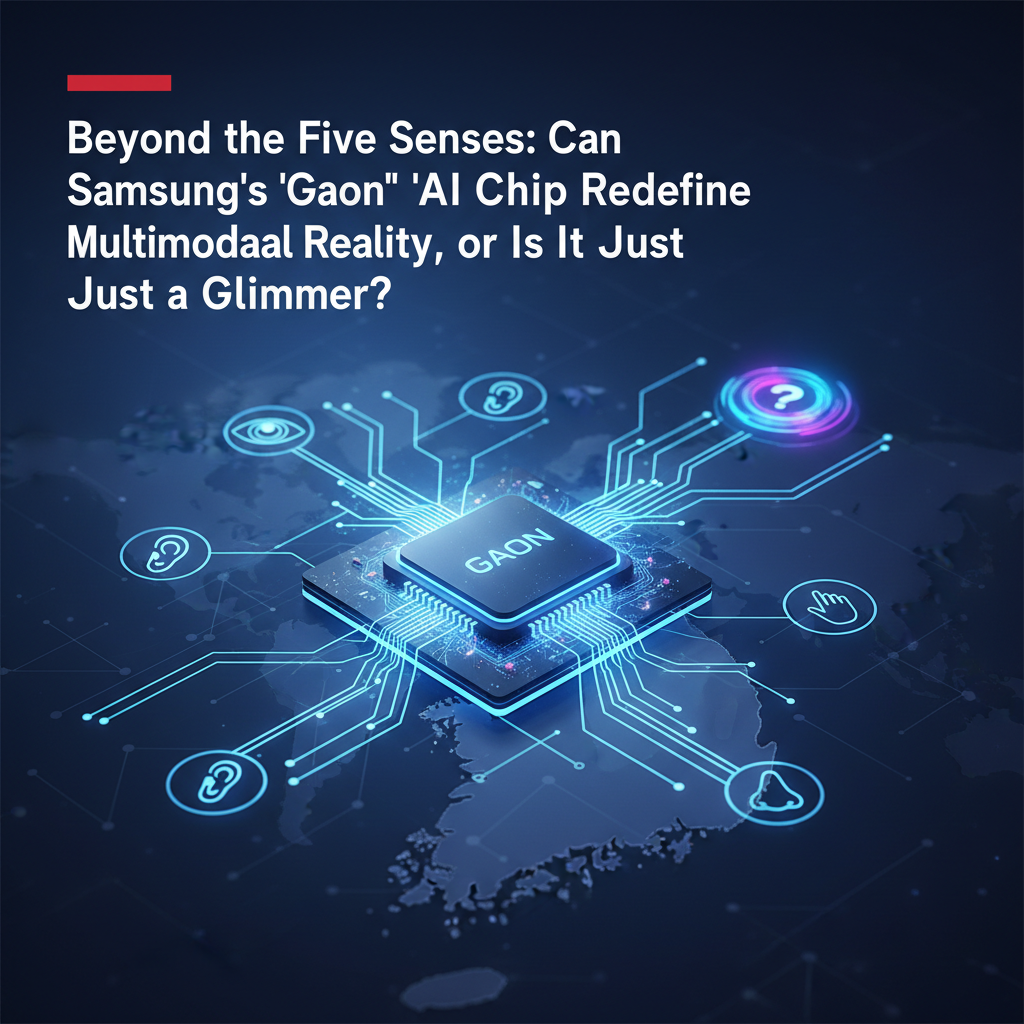
In South Korea, this trend is not merely observed, but actively shaped. Our hardware prowess, particularly in memory and specialized AI accelerators, positions us uniquely. Samsung's latest move reveals a deeper strategy, exemplified by their recent announcement of the 'Gaon' AI processing unit, specifically designed for on-device multimodal inference. This chip, slated for mass production by late 2026, boasts a novel heterogeneous architecture that integrates dedicated neural processing units for vision, audio, and language tasks, alongside high-bandwidth memory, allowing for extremely low-latency fusion of sensory data.