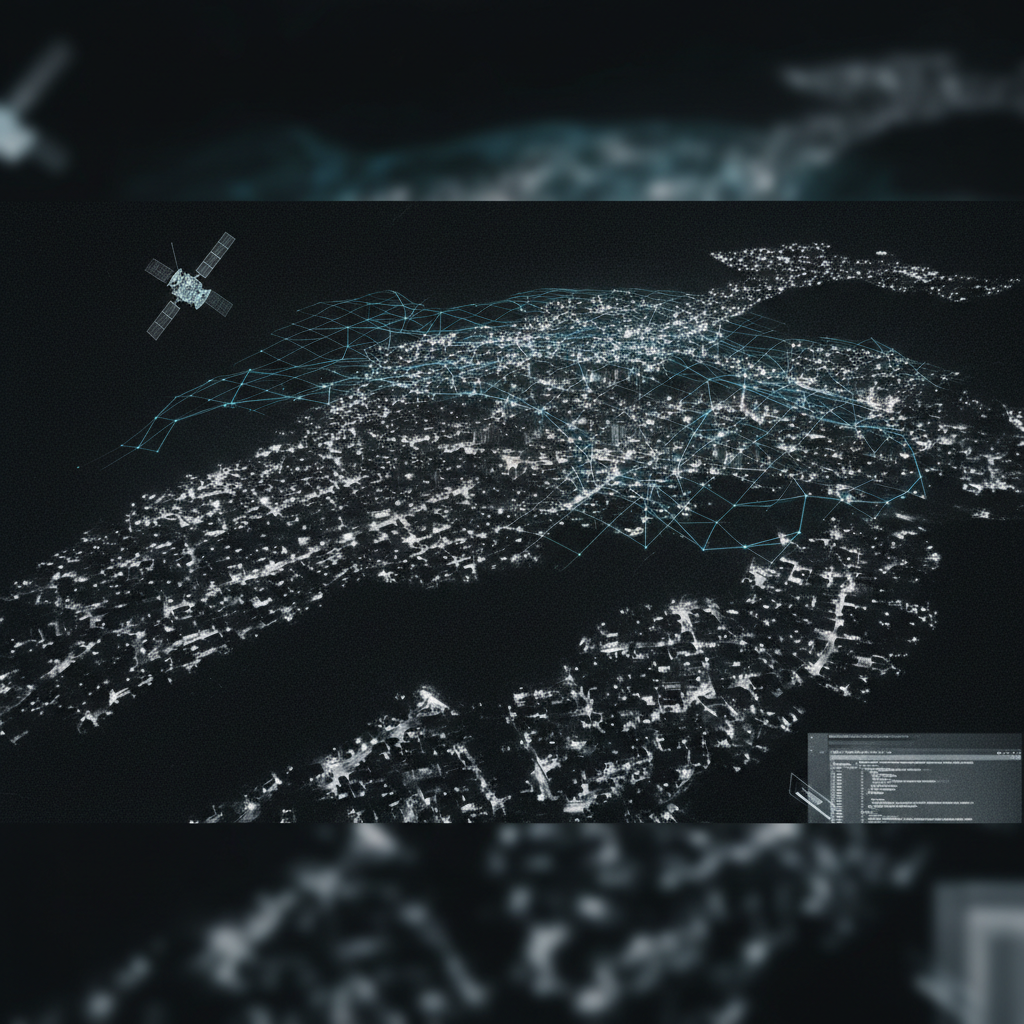

The promise of 'smart cities' often conjures images of efficient traffic flow, optimized public services, and enhanced safety. In Brazil, however, this vision is rapidly morphing into something more insidious: a pervasive, AI-driven surveillance apparatus that is charting the intimate lives of its citizens, particularly those in vulnerable communities. My investigation reveals that the investment trail leads to a surprising confluence of public funds and private technology, with Palantir Technologies playing a far more central, and opaque, role than previously understood.
For months, whispers have circulated in the corridors of power in Brasília and the bustling streets of São Paulo about a new generation of surveillance. It is not merely about the visible cameras on every corner, those ubiquitous eyes that citizens have, to some extent, come to accept. This is about the unseen algorithms, the predictive analytics, and the deep integration of disparate data sources that are painting a chillingly detailed picture of our society. Brazil's AI funding landscape hides surprises, and few are as unsettling as the quiet expansion of these capabilities.
My investigation began with a series of anonymous tips, corroborated by leaked procurement documents from several state and municipal security secretariats. These documents, which I have reviewed extensively, detail contracts for 'integrated urban intelligence platforms' that go far beyond standard Cctv management. They specify capabilities for facial recognition, gait analysis, predictive policing models, and, crucially, the aggregation of data from public records, social media, and even private utility consumption. The name that repeatedly surfaces in these contracts, often disguised under layers of subcontracting, is Palantir, the controversial American data analytics firm known for its work with intelligence agencies and law enforcement worldwide.
One document, originating from the Secretaria de Segurança Pública in Rio Grande do Sul, outlines a pilot project for 'proactive crime deterrence' in the metropolitan region. The technical specifications describe a system capable of ingesting data from over 20,000 public and private cameras, cross-referencing it with criminal databases, public transport records, and anonymized cellular location data. The estimated cost for the initial phase alone was R$85 million, approximately US$17 million at current exchange rates. A former project manager, speaking to me on condition of anonymity due to a strict non-disclosure agreement, confirmed Palantir's direct involvement. "They don't just sell software, they embed themselves," the source stated. "Their engineers were practically living in our data centers, helping us integrate everything. It was like building a digital panopticon, piece by piece."
The official narrative, of course, emphasizes safety. "Our priority is to protect our citizens and combat organized crime," declared Colonel Ricardo Mendes, head of the Integrated Operations Center in Salvador, Bahia, during a recent press conference. "These technologies are vital tools for modern policing, allowing us to respond faster and more effectively." He omitted any mention of the specific technology providers or the extent of data aggregation.
However, the evidence I have gathered suggests a different reality. A data scientist formerly employed by a Brazilian tech firm subcontracted for one of these projects revealed the true scope. "We were tasked with developing modules for 'behavioral anomaly detection' in public spaces," she explained, requesting her name be withheld. "This meant training AI models on vast datasets of pedestrian movements, social interactions, and even speech patterns. The goal was to identify 'suspicious' individuals or groups before an incident occurred. But the definition of 'suspicious' was incredibly vague and often correlated with socioeconomic indicators and racial profiles, not just criminal history."
This raises profound questions about algorithmic bias and its potential to disproportionately target marginalized communities, particularly the residents of Brazil's favelas. These informal settlements, often characterized by high population density and complex social dynamics, become fertile ground for such surveillance. The data collected could easily be used to reinforce existing prejudices, leading to increased police presence and scrutiny based on algorithmic predictions rather than concrete evidence. "When you deploy AI in a context like Brazil, where social inequality is so stark, you risk automating discrimination," warns Dr. Clara Almeida, a leading expert in digital rights at the Universidade de São Paulo. "The promise of safety becomes a pretext for control, especially over those who already lack political voice and legal protection. This is not about crime fighting alone; it is about social engineering."
Palantir, for its part, maintains a policy of not commenting on client engagements. Their public statements emphasize the ethical use of their platforms and their commitment to privacy safeguards. Yet, the contracts I examined contain clauses that grant the company significant access to the processed data for 'system optimization' and 'feature development,' raising concerns about data sovereignty and potential future monetization. This is a common tactic, where the line between service provider and data beneficiary blurs, allowing for an expansion of influence that is rarely transparent to the public.
The implications for civil liberties are staggering. Imagine a system that can track your movements, analyze your social network, and predict your likelihood of engaging in certain behaviors, all without your explicit consent or even your knowledge. In a country with a history of authoritarianism and social unrest, such tools present a clear and present danger to democratic freedoms. The very fabric of trust between citizens and the state is eroded when surveillance becomes this pervasive and opaque.
What does this mean for the public? It means that the 'smart city' narrative, so often championed by urban planners and tech evangelists, needs rigorous scrutiny. It means demanding transparency from our elected officials regarding these contracts and the technologies they deploy. It means questioning the true cost of 'safety' when it comes at the expense of fundamental rights. The digital transformation of our cities should empower citizens, not turn them into data points in a vast, unseen algorithm. Without immediate intervention and robust regulation, Brazil risks building a future where privacy is a relic of the past, and algorithmic control becomes the new normal. For more on the broader implications of AI in society, consider exploring analyses from MIT Technology Review. The debate around these powerful technologies is global, and Brazil stands at a critical juncture. Further insights into AI's societal impact can be found on platforms like Wired. We must ensure that technology serves humanity, not the other way around. For a perspective on how AI impacts other nations, one might consider an article about When AI Becomes the Censor: Why Nigeria Must Guard Its Digital Town Square From Silicon Valley's Algorithms, Mr. Zuckerberg [blocked], as the challenges of algorithmic control are not unique to Brazil.