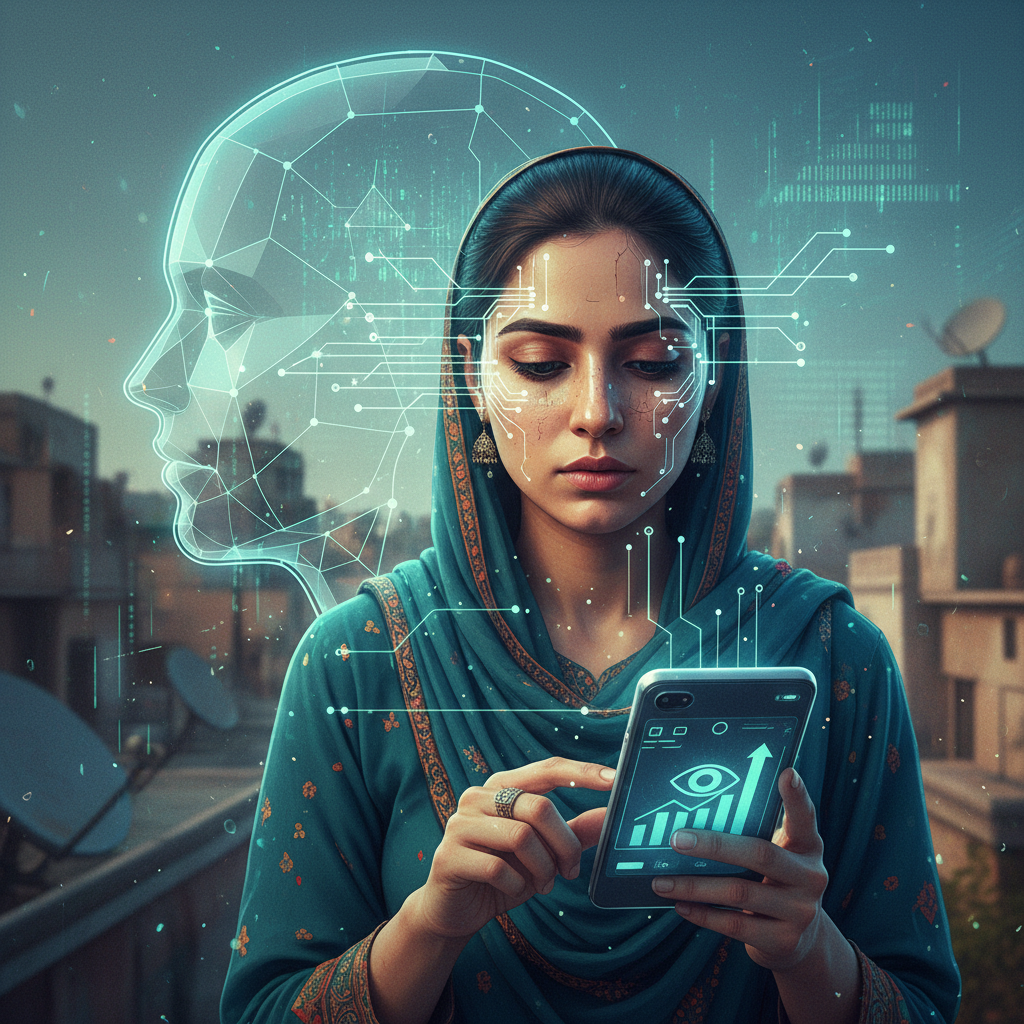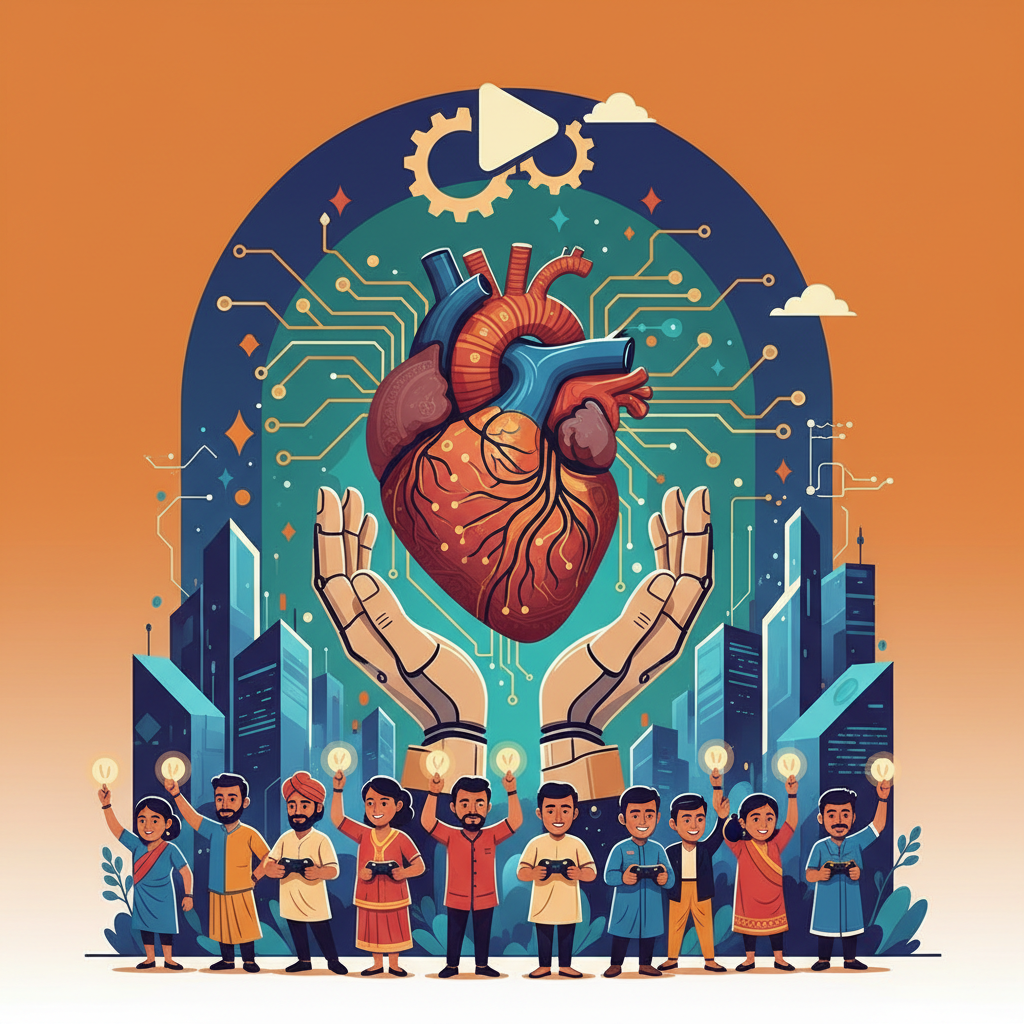

The air in Mumbai is always buzzing, a symphony of honking taxis, street vendors, and the endless chatter of dreams being chased. It is a city that thrives on stories, on drama, on the vibrant tapestry of human experience. And as I walk through its bustling lanes, past the old cinema halls and the new gaming cafes, I cannot help but feel a growing unease about the direction AI is taking in our beloved entertainment industry. Everyone is talking about generative AI creating endless game worlds, virtual actors, and personalized narratives. But is it truly creating, or just endlessly replicating? I believe we are at a crossroads, and India, with its rich heritage of storytelling and community, has a crucial role to play in steering this ship toward a more meaningful destination.
Let me be clear: the potential of AI in gaming and entertainment is immense. We are talking about games that adapt to your mood, films with dynamically generated scenes, and virtual companions that learn and grow with you. Imagine a game set in ancient Hampi, where every interaction with an NPC feels as real as talking to a local shopkeeper in Ahmedabad, their responses shaped by complex AI models. Or a personalized Bollywood musical where the songs and dances are choreographed on the fly, just for you. The global market is already seeing staggering growth, with projections suggesting AI in gaming alone could reach over $40 billion by 2028, according to some industry reports. Companies like NVIDIA are pushing the boundaries with AI-powered graphics and character animation, making virtual worlds almost indistinguishable from reality. Wired often covers these advancements, showcasing the technological marvels.
Yet, my heart tells me something is missing. In this relentless pursuit of technical perfection and infinite content, are we sacrificing the very essence of what makes art and entertainment so profoundly human? The unexpected glitch, the quirky character born from a developer's late-night whim, the shared experience of a finite, crafted story. When everything is personalized and algorithmically optimized, does it not risk becoming bland, predictable, and ultimately, isolating? This story will change how you think about the soul of digital entertainment, I promise you.
I recently spoke with Dr. Priya Sharma, a leading cultural anthropologist at the Indian Institute of Technology Bombay, who echoed my sentiments. 'The fear is not just about job displacement, though that is a valid concern,' she told me over a cup of chai. 'It is about the homogenization of culture. If AI models are trained predominantly on Western datasets, will our uniquely Indian narratives, our folk tales, our classical arts, find their authentic voice in these new digital realms, or will they be diluted, flattened into something generic?' She raises a powerful point. Our cultural nuances, the intricate dance of emotions in a Kathak performance, the subtle humor in a Gujarati play, these are not easily quantifiable by algorithms. They require a human touch, a lived understanding.
Some might argue that AI will simply be a tool, an enabler for artists to create more efficiently and on a grander scale. They will say that generative AI can free up developers from repetitive tasks, allowing them to focus on core creative vision. 'Think of it as a super-powered paintbrush,' offered Rohan Kapoor, CEO of 'IndieVerse Studios,' a promising gaming startup in Bengaluru. 'We can generate thousands of unique assets in minutes, allowing our small team to build worlds that would have taken hundreds of artists years. It democratizes creation.' His studio, by the way, is experimenting with AI to create procedurally generated levels inspired by ancient Indian architecture, a fascinating concept. You can read more about such startups on TechCrunch sometimes.
But I contend that this 'efficiency' can come at a cost. The very constraints that force human artists to be ingenious, to find novel solutions, are often what lead to truly groundbreaking and memorable works. If AI can instantly generate a thousand variations of a character, does the artist still pour their soul into that one perfect design? Does the audience still feel that connection to a character born from a specific, human struggle? I believe that the human element, the 'soul' in the machine, is what truly resonates. We connect with the imperfections, the unique perspectives that only a human can bring. A perfectly rendered, algorithmically generated face might be beautiful, but does it have the depth of expression we see in a character crafted by a master animator, someone who understands the subtle language of human emotion?
Consider the traditional Indian art forms. A weaver creating a Kanchipuram silk saree, each thread meticulously placed, each motif carrying generations of cultural stories. Or a classical musician, whose performance is not just about hitting the right notes, but about the bhava, the emotion, the spontaneous improvisation that makes each rendition unique. Can AI truly replicate that? Can it infuse a digital game or film with the rasa, the aesthetic flavor, that is so central to Indian art? I am skeptical.
Meet the woman who is trying to bridge this gap, however. Anjali Desai, a game designer from Pune, is developing a narrative game that uses AI, not to generate content, but to understand and reflect player emotions, guiding them through a story deeply rooted in Indian mythology. 'Our AI is like a sensitive listener, not a storyteller,' Anjali explained to me. 'It helps us craft a more empathetic experience, but the core narrative, the heart of the story, that is entirely human.' Her approach is a breath of fresh air, a reminder that AI can augment, not necessarily replace, the human creative spirit.
My call to action is simple, yet profound: India must champion a human-centric approach to AI in entertainment. We need to invest in research that focuses on how AI can enhance human creativity, preserve cultural authenticity, and foster genuine connection, rather than just chasing hyper-realism or infinite content. We should encourage our developers and artists to use AI as a collaborator, a tool to amplify their unique voices, not to overshadow them. Let us build platforms that celebrate our diverse stories, our regional languages, our rich traditions, and use AI to make them accessible and engaging to a global audience, without losing their essence. Let our AI be inspired by the vibrant chaos of a crowded Indian bazaar, not just the sterile perfection of a data center.
If we are not careful, the promise of AI in gaming and entertainment could turn into a gilded cage, trapping us in a loop of algorithmically optimized, emotionally hollow experiences. But if we approach it with wisdom, with a deep respect for human creativity and cultural heritage, we can truly unlock its potential. We can create digital worlds that not only entertain, but also enlighten, connect, and celebrate the beautiful, messy, unpredictable tapestry of human life. This is the future I dream of, a future where technology serves humanity, not the other way around.