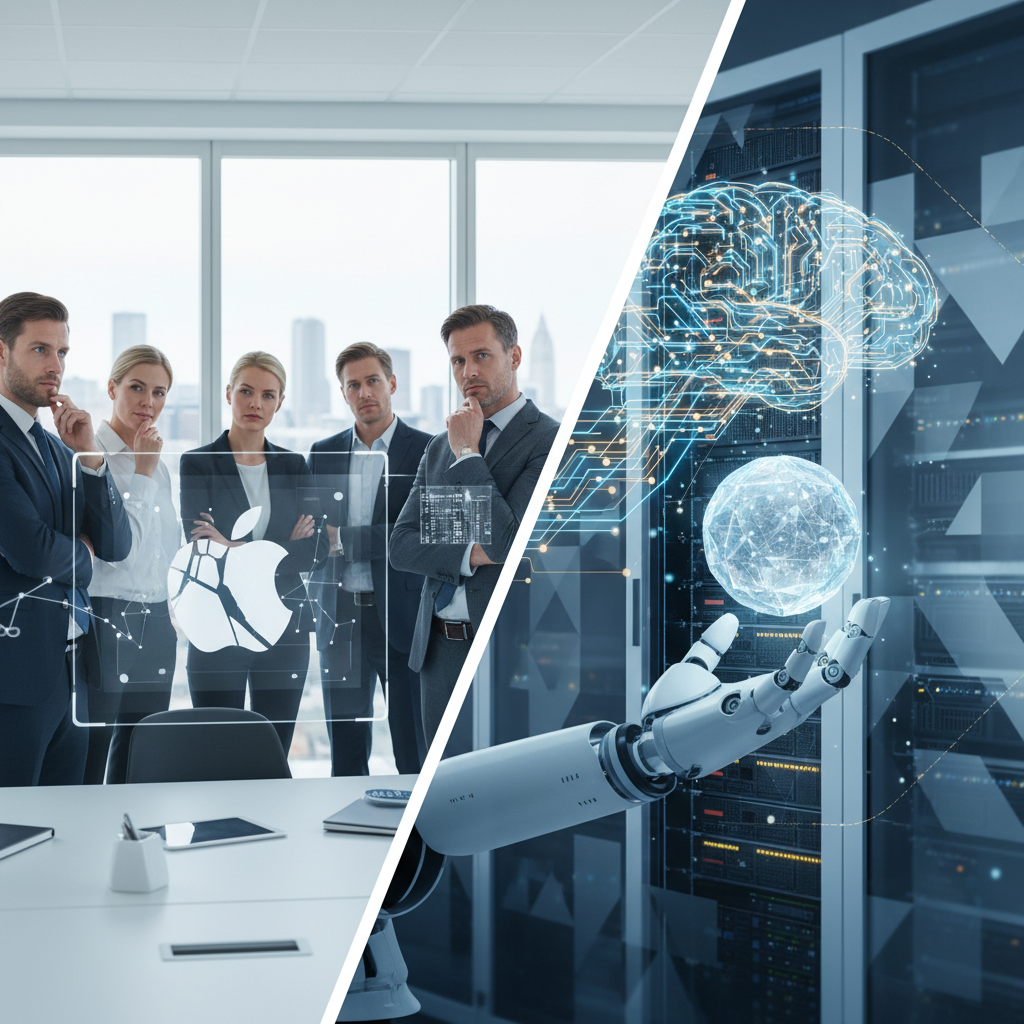

The fluorescent hum of the open-plan office at a mid-sized Stockholm fintech firm, a scene familiar across Sweden, masks a quiet revolution, or perhaps, a simmering skepticism. Employees, many equipped with Apple devices, are increasingly aware of the company's pronouncements on artificial intelligence. Yet, the integration of Apple's much-lauded privacy-first AI into their daily enterprise workflows remains conspicuously limited. This discrepancy, between the public narrative and practical application, forms the core of a critical inquiry into Apple's impact on the European, and specifically Swedish, business landscape.
Apple, under the leadership of Tim Cook, has consistently positioned itself as the vanguard of user privacy, a stance that resonates deeply within a society where data protection is not merely a legal requirement but a cultural expectation. The company's on-device processing for features like Siri and its recent generative AI advancements, which largely avoid cloud-based data aggregation, are presented as a bulwark against the data-hungry models of competitors. However, for Swedish enterprises, the question is not simply whether the technology is private, but whether it is truly useful and integrable within existing, often complex, IT infrastructures.
Let's look at the evidence. A recent survey conducted by the Swedish Chamber of Commerce, involving over 200 local businesses, indicated that while 78 percent of respondents used Apple products within their organizations, only 14 percent had actively explored or implemented Apple's AI functionalities for core business processes beyond basic productivity tools. This contrasts sharply with the 45 percent who reported experimenting with Microsoft's Copilot or Google's Gemini for enterprise applications. The disparity suggests a fundamental disconnect between perceived privacy benefits and tangible business value.
“The promise of privacy is appealing, certainly, but enterprise AI requires more than just secure processing on a device,” stated Dr. Elin Karlsson, a senior analyst at the Swedish Institute for Enterprise Development. “It demands robust integration capabilities, granular control over data flows, and often, the ability to leverage proprietary datasets in a secure, yet centralized, manner. Apple’s ecosystem, while secure, can feel somewhat closed off for these advanced use cases.” Her observations align with the experiences of many IT managers struggling with data silos and interoperability challenges.
The adoption data paints a clearer picture. While Apple's consumer market share in Sweden remains robust, its penetration into the enterprise AI stack is modest. IDC's latest report on European enterprise AI spending, released in early 2026, highlighted that investments in Apple's AI solutions constituted less than 5 percent of the total AI software market in the Nordics, trailing significantly behind offerings from Microsoft, Google, and even specialized European AI startups like Mistral AI. This indicates that despite the privacy narrative, businesses are prioritizing flexibility, existing infrastructure compatibility, and a broader range of AI capabilities.
Consider the case of Klarna, the Swedish fintech giant. While Klarna's workforce undoubtedly utilizes Apple devices, their strategic AI initiatives, particularly in fraud detection and customer service automation, rely heavily on custom-built models and cloud-agnostic platforms. “Our focus is on explainability and control, alongside privacy,” explained a senior data scientist at Klarna, who requested anonymity due to company policy. “We need to understand exactly how our models operate and how data is being used, not just trust a black box, however private it claims to be.” This sentiment echoes throughout the Swedish tech sector, where transparency is often valued as highly as privacy itself.
Who are the winners and losers in this scenario? Companies heavily invested in the Apple ecosystem for creative work, such as design studios or marketing agencies, find some value in on-device AI for tasks like image editing or content generation, benefiting from the seamless integration. However, enterprises requiring deep data analysis, complex automation, or large-scale machine learning operations often find Apple's offerings insufficient or too restrictive. The Swedish model suggests a different approach, one that values open standards and interoperability, fostering competition and innovation rather than relying on a single vendor's walled garden.
Worker perspectives also reveal a nuanced reality. While employees appreciate the privacy assurances, the practical impact on their daily tasks is often limited. “Siri is useful for setting reminders, but it doesn’t help me analyze market trends or automate my report generation,” remarked a business analyst at a major Swedish bank. The perceived utility of enterprise AI from Apple often falls short of the transformative potential promised by other platforms, leading to a reliance on alternative tools for more demanding tasks. This fragmented approach can introduce its own set of security and privacy challenges, as employees navigate multiple systems.
Expert analysis frequently points to Apple's historical reluctance to fully open its ecosystem. While this has been a cornerstone of its brand identity and security posture, it presents a hurdle for enterprise adoption. “Apple’s strength is its integrated experience, but that integration often comes at the cost of external flexibility,” observed Dr. Andreas Nilsson, a professor of information systems at the Royal Institute of Technology in Stockholm. “For businesses, especially those operating under strict European data regulations like GDPR, the ability to audit, customize, and integrate AI solutions with diverse data sources is paramount. Apple’s current enterprise AI strategy, while privacy-conscious, does not always meet these complex demands.” Read more about enterprise AI adoption trends.
Looking ahead, the landscape is evolving. The European Union's AI Act, set to be fully implemented, will impose stringent requirements on AI systems, particularly those deemed high-risk. This regulatory environment could either bolster Apple's privacy-first approach, given its emphasis on secure processing, or expose its limitations if its closed ecosystem hinders necessary transparency and auditability. The challenge for Apple will be to evolve its enterprise AI offerings to not only promise privacy but also deliver the robust, customizable, and auditable solutions that European businesses, particularly those in Sweden, demand. Without this evolution, Apple risks remaining a niche player in the broader enterprise AI market, despite its formidable consumer presence and privacy credentials. The market demands more than just a secure black box; it requires a transparent, adaptable, and truly intelligent partner. For deeper insights into AI research and analysis, visit MIT Technology Review.
The question remains: can Apple reconcile its tightly controlled ecosystem with the open, flexible, and auditable AI solutions that European enterprises require? Or will its privacy-first stance, however commendable, ultimately limit its impact in a market hungry for practical, scalable, and transparent AI innovation? The evidence from Sweden suggests that the answer is not yet clear, and businesses are not waiting idly for Cupertino to decide.