
The buzz around Apple's M-series chips and their promise of on-device, local AI is deafening. From Cupertino to Lagos, tech enthusiasts are hailing it as a paradigm shift, a liberation from the cloud, a new era of privacy and efficiency. Your iPhone, your MacBook, now a miniature AI powerhouse, processing complex models without ever sending your data to some distant server farm. It sounds revolutionary, doesn't it? Like a breath of fresh air in a world suffocated by data breaches and surveillance capitalism. But here in Nigeria, where the digital landscape is often shaped by the whims of global tech giants, I find myself asking: is this truly a gift, or a more sophisticated form of digital colonialism?
Let's cast our minds back a bit, shall we? For decades, the narrative has been clear: the future is in the cloud. Centralized servers, massive data centers, everything connected, everything accessible from anywhere. This model, championed by the likes of Amazon Web Services, Google Cloud, and Microsoft Azure, has been undeniably powerful. It democratized access to computing resources, allowing startups in Yaba to leverage infrastructure that would have been unthinkable a generation ago. However, it also created a dependency. We became tenants in someone else's digital property, our data residing on their servers, subject to their terms, their security protocols, and ultimately, their jurisdiction. This is not a uniquely Nigerian problem, mind you, but in a continent striving for digital self-determination, it hits differently.
Now, Apple, with its characteristic flair, is shifting the goalposts. Their M-series chips, designed with dedicated neural engines, are pushing AI processing to the edge, right onto your device. The latest M3 and M4 chips boast neural engines capable of trillions of operations per second, specifically optimized for machine learning tasks. This means that generative AI models, complex image processing, and even advanced voice recognition can happen directly on your iPhone 16 or MacBook Pro, without an internet connection. Tim Cook and his team are pitching this as a major win for user privacy and speed. And on the surface, it is compelling. Imagine a world where your personal assistant truly understands you without sending your most intimate queries to a remote data center. Imagine creative tools that generate stunning visuals instantly, all within the confines of your device. It's a powerful vision, one that resonates deeply with the growing global concern for data sovereignty.
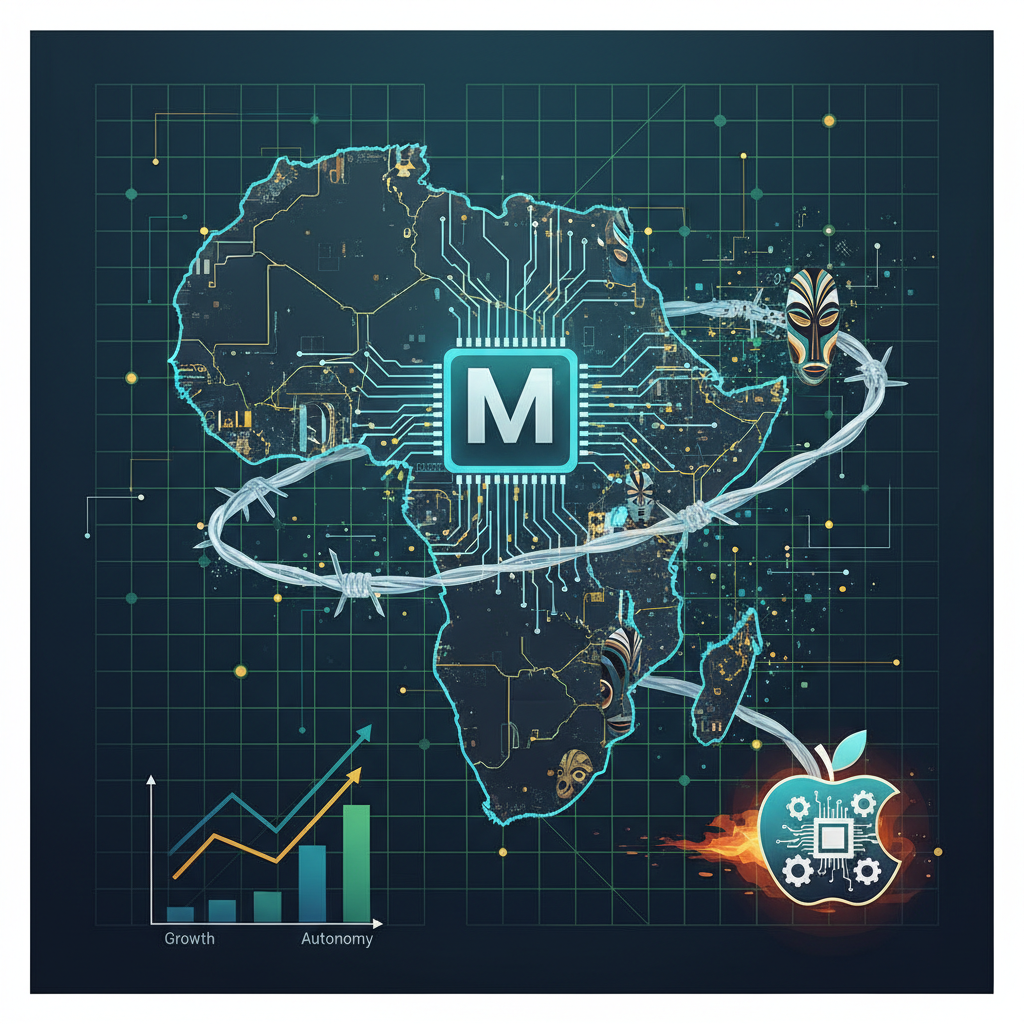
But let's talk about what nobody wants to discuss. While the technical prowess of Apple's M-series chips is undeniable, and the privacy benefits for individual users are significant, we must look beyond the immediate gratification. Everyone's celebrating, but I have questions. Who controls the models that run on these chips? Who dictates the updates, the capabilities, the very parameters of this 'local' AI? Apple, of course. While the processing happens on your device, the foundational architecture, the training data, the software ecosystem, all remain firmly within Apple's walled garden. This isn't true digital independence; it's a new form of technological lock-in, albeit a very comfortable one.
Consider the implications for developers and innovators in places like Nigeria. While the M-series offers incredible power, developing for this ecosystem requires adherence to Apple's stringent guidelines and tools. It means building within their framework, paying their fees, and ultimately, being subject to their strategic direction. This can stifle local innovation that seeks to build truly open, community-driven AI solutions. As Professor Ndubuisi Ekekwe, a prominent Nigerian tech entrepreneur and academic, often argues, "Innovation thrives not just on powerful hardware, but on open access and the freedom to build without undue external control." He emphasizes that true technological empowerment comes from owning the stack, not just consuming its output.
Furthermore, the cost of entry is not negligible. Apple devices, while aspirational, remain premium products. In a country where average incomes are significantly lower than in the West, the latest M-series powered devices are a luxury item, not a ubiquitous tool. This creates a digital divide within the 'local AI' revolution itself. While a select few can enjoy the benefits of on-device processing, the majority remain reliant on older, less capable hardware, or cloud-based solutions that are often more accessible through cheaper Android devices. This perpetuates a two-tiered digital society, where the most advanced, privacy-preserving technologies are reserved for the privileged.
Even the privacy argument, while strong, has nuances. While your data might not leave your device for processing, the very algorithms that process it are designed and controlled by Apple. Their definition of 'privacy' might not align perfectly with local cultural norms or regulatory frameworks. For instance, in Nigeria, discussions around data privacy and digital rights are evolving, with initiatives like the Nigeria Data Protection Act aiming to safeguard citizen information. However, when the underlying technology is opaque and controlled by a foreign entity, true data governance becomes a complex dance. As Dr. Olumide Akintayo, a legal expert specializing in technology law in Lagos, recently stated, "On-device processing is a step forward for individual privacy, but it does not absolve us of the need for robust regulatory oversight and transparency from the tech giants who design these systems." He stressed the importance of understanding the 'black box' of these algorithms, even when they operate locally.
My unpopular opinion is this: Apple's M-series chips, while technologically brilliant, represent a strategic move to solidify their ecosystem control, rather than a genuine push for decentralized digital power. It’s like being given a magnificent, self-sufficient generator for your compound, but the fuel and maintenance are still exclusively supplied by the company that sold it to you. You have power, yes, but not true energy independence. The data processing might be local, but the intellectual property, the control, the economic value, largely remains offshore.
This isn't to say that on-device AI is without merit. For specific applications, particularly in areas with unreliable internet connectivity, or for highly sensitive personal data, it offers undeniable advantages. Imagine medical diagnostics running on a tablet in a rural clinic, processing patient data without needing to connect to a central server. Or educational tools that adapt to a student's learning style, all locally. These are powerful use cases that could genuinely benefit communities across Africa. However, we must be vigilant. We must demand transparency. We must push for open standards and interoperability. We must ensure that the 'local' in local AI truly empowers local communities, local developers, and local economies, not just the global behemoths.
Ultimately, the trend of on-device AI, powered by chips like Apple's M-series, is here to stay. It's not a fad; it's the new normal for high-performance computing. But for us in Africa, the question isn't just about what these chips can do, but what they mean for our digital future. Are we merely consumers of another sophisticated foreign technology, or can we leverage this shift to build our own, truly sovereign digital infrastructure? The answer, as always, lies in our ability to critically engage, to demand better, and to build our own solutions. We cannot afford to be passive recipients of technological progress; we must be active participants, shaping it to serve our own unique needs and aspirations. For more insights on the broader implications of tech giants in Africa, you might find this article on Microsoft's Azure AI in Lusaka [blocked] illuminating. For more on the technical side of AI advancements, consider reading up on recent AI developments or exploring in-depth analysis from MIT Technology Review. The conversation around digital sovereignty and technological self-determination is far from over. In fact, with local AI, it's only just beginning.