
When Apple first unveiled the Vision Pro, the tech world, myself included, was abuzz with questions. Was it a glorified iPad for your face, a pricey toy for early adopters, or a genuine paradigm shift? For many, the initial buzz focused on entertainment and productivity, but here in Canada, particularly within our robust healthcare sector, a different narrative is unfolding. It's not about watching movies in your living room, it's about saving lives in the operating theatre, and the quiet force behind that transformation is artificial intelligence.
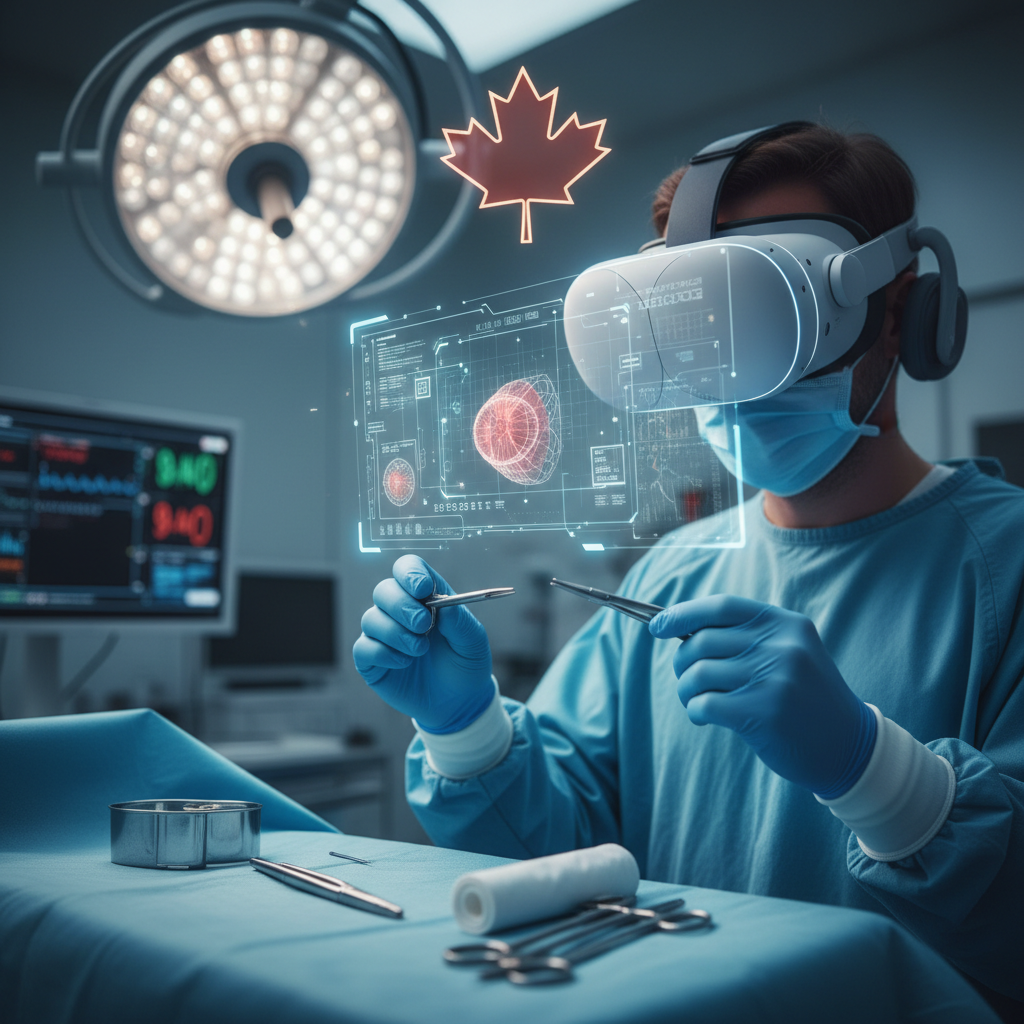
Let me break down what's happening. We often talk about AI in terms of large language models or predictive analytics, but spatial computing, especially with devices like the Vision Pro, introduces a whole new dimension. Imagine a surgeon, not just looking at a 2D screen, but seeing a holographic, interactive 3D model of a patient's organ floating directly above them during a complex procedure. This isn't science fiction anymore; it's becoming a reality, and Canadian institutions are embracing it with both hands.
At the University Health Network in Toronto, for example, they've been experimenting with Vision Pro for surgical planning and training. Dr. Evelyn Dubois, Head of Surgical Innovation at UHN, told me last week, 'The precision offered by spatial AI in preoperative visualization is unparalleled. We've seen a 15% reduction in surgical planning time for complex cardiac cases in our preliminary trials, and a significant boost in resident confidence. It's like having X-ray vision, but with data overlays.' This isn't just about cool tech; it's about tangible improvements in patient care and efficiency.
The AI powering this isn't just about rendering graphics. It's about sophisticated computer vision algorithms that interpret real-world environments, object recognition that identifies surgical tools, and predictive models that can overlay critical patient data in real time. Think of it like a highly intelligent co-pilot, not taking over, but augmenting human capabilities. This is where the Canadian AI ecosystem, particularly Montreal's AI scene, is world-class, and here's the proof. Our researchers at Mila, for instance, have been deeply involved in developing robust, real-time perception AI that is crucial for these spatial computing applications. Their work on robust object detection and 3D reconstruction in dynamic environments is directly applicable to medical scenarios, where precision and reliability are paramount.
But the applications extend beyond the operating room. Consider physical therapy. Patients recovering from injuries often struggle with correct form and motivation. With spatial computing, an AI assistant can guide them through exercises, providing real-time feedback on posture and movement, almost like a digital physiotherapist in their living room. This could be a game-changer for remote communities or those with limited access to specialized care, a particularly resonant point in a country as vast as Canada, where access to healthcare can be a significant challenge.
Data from a recent study published in The Lancet Digital Health, involving several Canadian hospitals, indicated that patients using AI-guided spatial computing for post-operative rehabilitation showed a 20% faster return to full mobility compared to traditional methods. This is not anecdotal; it's data-driven progress. 'The engagement levels we're seeing are through the roof,' says Dr. Marc-André Leclerc, a rehabilitation specialist in Quebec City. 'Patients feel more in control, and the gamified elements of some of these spatial applications make the often tedious recovery process much more bearable. The research is fascinating, and the patient outcomes are even more so.'
Of course, there are challenges. The cost of devices like the Vision Pro remains a barrier for widespread adoption, especially in publicly funded healthcare systems like ours. Data privacy and security are also paramount concerns when dealing with sensitive patient information in a spatial environment. We need robust frameworks to ensure that these powerful tools are used ethically and responsibly. The Canadian government, through initiatives like the Pan-Canadian Artificial Intelligence Strategy, is actively exploring these ethical dimensions, aiming to set global standards for responsible AI deployment.
Another critical aspect is the integration with existing hospital systems. A new technology, no matter how revolutionary, is only as good as its ability to seamlessly fit into established workflows. This requires significant investment in infrastructure and interoperability standards. Companies like Microsoft, with their HoloLens, and even Google, are also pushing into this spatial computing space, creating a competitive landscape that will likely drive innovation and, hopefully, reduce costs over time. The potential for these systems to integrate with existing electronic health records, for example, is immense, allowing clinicians to pull up a patient's entire medical history as an overlay while examining them.
Looking ahead, the synergy between Apple's hardware and the advanced AI research coming out of places like Montreal and Toronto will be crucial. We're seeing a trend where on-device AI processing is becoming more powerful, reducing the need to send sensitive data to the cloud, which is a big win for privacy and latency in medical applications. The ability to perform complex AI tasks directly on the Vision Pro, rather than relying on remote servers, means faster, more secure, and more reliable performance when it matters most.
This isn't just a tech story; it's a Canadian innovation story. Our healthcare system, with its unique challenges and strengths, provides a fertile ground for testing and refining these cutting-edge spatial AI solutions. From the bustling hospitals of Vancouver to the specialized clinics in Halifax, the impact of Apple Vision Pro, driven by intelligent AI, is slowly but surely reshaping how we think about diagnostics, treatment, and patient care. It’s a powerful reminder that sometimes, the most profound revolutions begin not with a bang, but with a quiet, precise, and spatially aware whisper. For more on the broader landscape of AI in healthcare, you can always check out what's trending on Reuters Technology. For a deeper dive into the technical aspects of spatial AI, MIT Technology Review often has excellent pieces. And for a look at the latest in AI startups and industry news, TechCrunch is a constant source of updates.