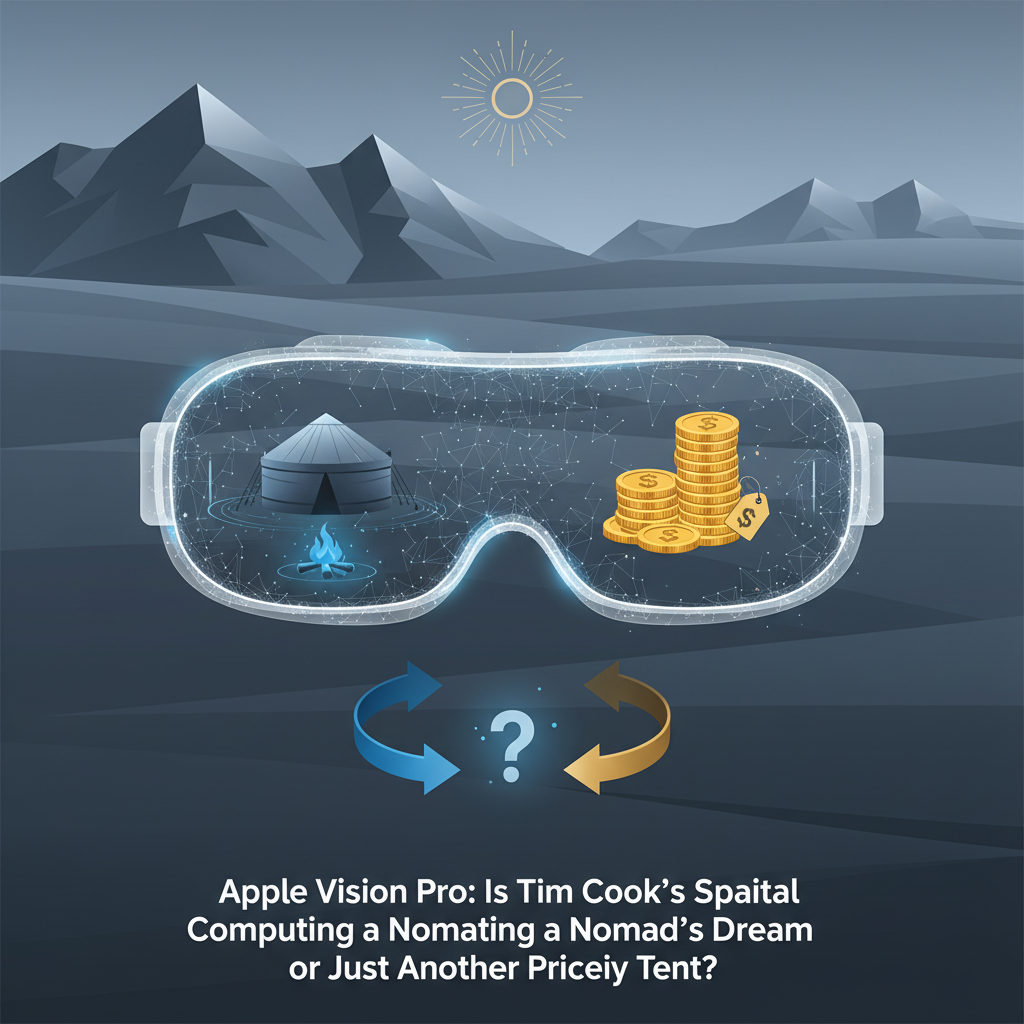

Is Apple Vision Pro, with its shiny optics and ambitious spatial computing, a genuine revolution or just another expensive distraction? That is the question many are asking, and from my vantage point here in Ulaanbaatar, the answer is far from clear. We have seen enough technological fads come and go to approach any new gadget, especially one costing thousands of dollars, with a healthy dose of skepticism.
Apple introduced Vision Pro in early 2024, positioning it as a device that seamlessly blends digital content with the physical world. It is not just virtual reality, they say, but 'spatial computing,' a new paradigm. The device runs on visionOS, Apple's first spatial operating system, and relies heavily on advanced AI for everything from hand tracking and eye tracking to environmental understanding and rendering realistic digital objects within a real space. The core idea is to move beyond flat screens and interact with information in a three dimensional environment, using natural gestures and eye movements. It is a bold vision, one that promises to reshape how we work, communicate, and entertain ourselves.
Historically, augmented and virtual reality have had a bumpy road. Remember Google Glass? It was an early attempt at wearable tech that promised a lot but delivered little beyond social awkwardness and privacy concerns. Meta, under Mark Zuckerberg, poured billions into its metaverse vision, rebranding the entire company around it. While Meta Quest headsets have found a niche, particularly in gaming, widespread adoption for daily productivity or social interaction remains elusive. The challenge has always been the clunkiness, the isolation, and the lack of truly compelling applications that justify the cost and the immersion. Apple, with its reputation for polish and user experience, aims to overcome these hurdles.
Now, in April 2026, Vision Pro has been on the market for over a year. Initial sales figures were respectable for a premium device, reportedly selling around 200,000 units in its first few months. However, the initial buzz has somewhat tempered. While early adopters praised the display quality and the intuitive interface, common criticisms include its weight, battery life, and the limited number of truly 'killer' applications beyond media consumption and some specialized professional uses. Analysts at Counterpoint Research noted in late 2025 that while the enterprise sector showed promising interest for specific training and design applications, consumer uptake was still largely driven by novelty rather than necessity. This is a familiar pattern in tech, where early enthusiasm often outpaces practical utility.
The role of AI in Vision Pro is not just a feature, it is the bedrock. Without sophisticated machine learning algorithms, the device would be little more than a fancy headset. The AI powers its ability to understand your environment, map your room, track your gaze, and interpret your hand gestures with remarkable accuracy. It is what allows a digital window to appear anchored to a real wall, or a virtual dinosaur to stomp across your living room floor. This is where the 'spatial computing' truly differentiates itself from simpler VR. It is an AI driven perception engine that constantly processes vast amounts of data from its array of cameras and sensors.
I spoke with Dr. Enkhjargal Batbayar, a professor of computer science at the National University of Mongolia. She highlighted the immense computational power required. "The real magic of Vision Pro is in its on device AI," she explained. "It is performing complex real time semantic segmentation and object recognition, all while maintaining a smooth user experience. This level of local processing, minimizing latency, is critical for spatial computing to feel natural, not jarring." She added that while the consumer applications are still developing, the underlying AI capabilities are genuinely impressive. "This is not just about showing a picture, it is about understanding the world around you and augmenting it intelligently." MIT Technology Review has also extensively covered the foundational AI advancements enabling such seamless integration.
However, the question remains: who is this for, especially outside the tech hubs? Here in Mongolia, where vast distances and often challenging infrastructure are a daily reality, a device like Vision Pro feels like a luxury from another planet. Our needs are different. We are more concerned with reliable internet access for remote education and telemedicine, or with using AI to optimize livestock management on the steppe. The steppe meets the server farm, but the server farm needs to solve real problems, not just create new ways to watch movies.
Consider the practicalities. The device requires a relatively stable environment, good lighting, and a certain amount of clear space to operate effectively. For a herder living in a ger, or a miner working in a remote camp, these conditions are not always met. The battery life, reportedly around two to three hours, is also a significant limitation in places where consistent power sources are not guaranteed. While the concept of remote collaboration or immersive training could be transformative for industries like mining, the current iteration of Vision Pro is simply not rugged enough, nor is its ecosystem mature enough, to handle such demands.
Yet, there is potential. Practical innovation is what truly matters. Imagine a future, perhaps a decade from now, where spatial computing devices are lightweight, long lasting, and affordable. Then, perhaps, a veterinarian in Dornogovi could use an AR overlay to diagnose an animal without needing to be physically present, guided by an AI assistant. Or a student in a remote soum could attend a virtual class with interactive 3D models, overcoming geographical barriers. Mongolia's challenges are unique and so are its solutions, and affordable, robust spatial computing could be one of them.
Dr. Tsendmaa Ganbold, CEO of 'NomadTech Solutions,' a Mongolian startup focused on AI for remote sensing, shared a pragmatic view. "Apple Vision Pro is a fascinating piece of engineering, no doubt," she said. "But for us, the focus is on utility. Can it help us monitor pasture health more efficiently? Can it assist in geological surveys in harsh conditions? Right now, the answer is no, not directly. The hardware is too delicate and the software ecosystem is too consumer centric. We need enterprise grade solutions that are durable and integrate with our existing data pipelines, not just a fancy display." Her company, for example, leverages satellite imagery and AI to predict drought conditions, a far more pressing concern.
From a global perspective, the trend is clear: major tech players are investing heavily in spatial computing. Samsung recently unveiled its own mixed reality headset, reportedly in partnership with Google and Qualcomm, signaling a broader industry push. Meta continues to iterate on its Quest line, and other startups are exploring niche applications. The market for Ar/vr headsets is projected to grow significantly, with IDC forecasting shipments to reach over 30 million units by 2029, up from around 8 million in 2023. Much of this growth is expected to be driven by enterprise adoption and the eventual maturation of consumer applications, heavily reliant on increasingly sophisticated AI. You can follow industry developments on TechCrunch for more details.
My verdict? Apple Vision Pro is not a fad in the traditional sense. It is a foundational step, a very expensive and somewhat unwieldy prototype for a future that is undeniably coming. The AI within it is genuinely groundbreaking, setting a new standard for on device perception and interaction. However, for most people, and certainly for those of us navigating the realities of places like Mongolia, it is not yet the 'new normal.' It is a luxury item, a proof of concept. The real test will be when the technology becomes invisible, affordable, and truly integrated into our daily lives, solving problems we did not even know we had, rather than creating new ones. Until then, it remains a powerful vision, but one still largely confined to the comfortable, well connected urban spaces of the world. The vast, open spaces of the steppe are still waiting for spatial computing to truly earn its stripes. For now, we continue to build our own solutions, grounded in our unique environment and our enduring needs. The promise is there, but the practicality needs time to catch up. For now, the future of spatial computing is still being rendered, pixel by pixel, in labs far from our gers.