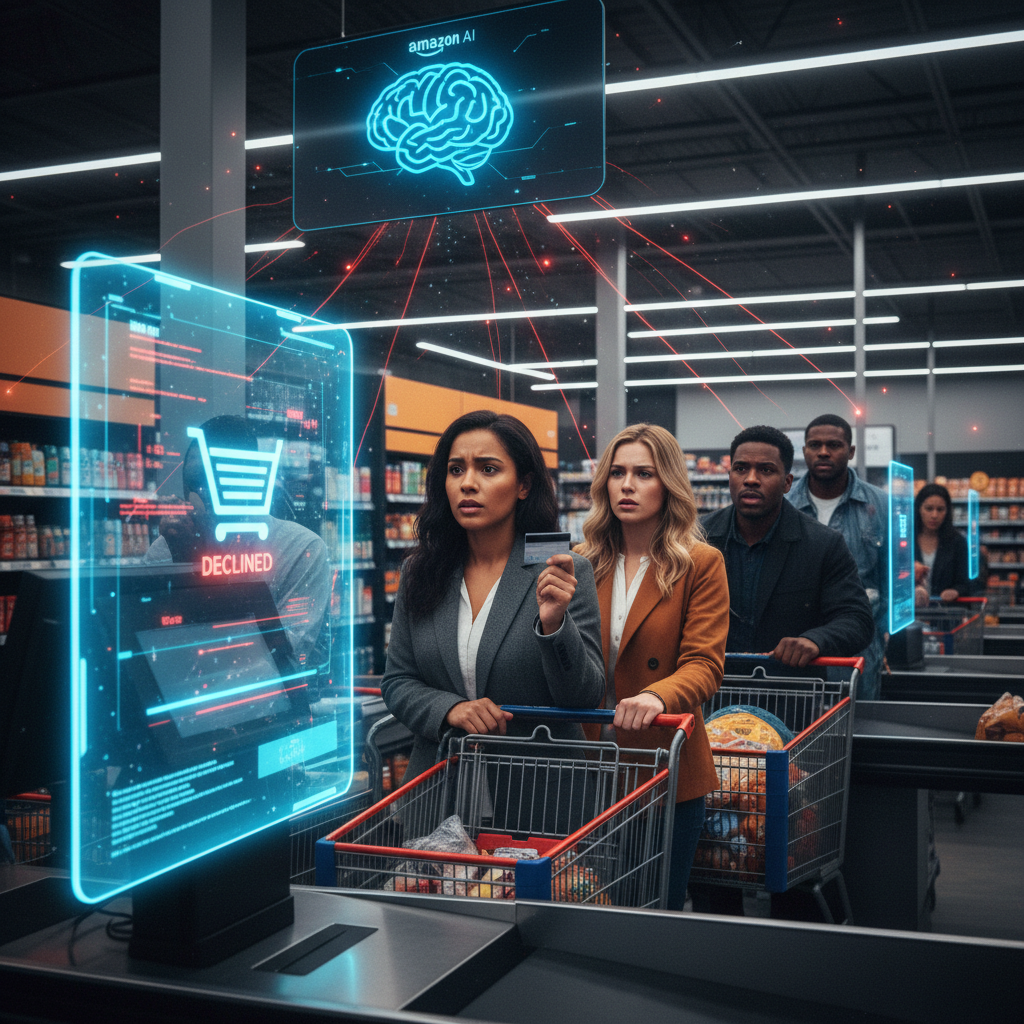

Let's be real. When Silicon Valley rolls out some shiny new AI, the headlines usually sing its praises, right? Efficiency, innovation, convenience. Blah, blah, blah. But I'm Deshawné Thompsòn, and I'm here to tell you that sometimes, that shiny new thing is just a digital coat of paint on an old, ugly problem. Today, that problem is Amazon's aggressive expansion of its AI-powered retail infrastructure across the USA, specifically its new 'Predictive Retail Hub' initiative.
This isn't just about getting your toilet paper delivered faster. We're talking about a massive, interconnected system designed to forecast demand, optimize inventory, and personalize shopping experiences on a scale we've never seen. Amazon just announced a $5 billion investment over the next two years to integrate this AI across its physical stores, its Whole Foods chain, and even third-party retail partners. The official line is that it will reduce waste, cut costs, and make shopping a dream. My question is, a dream for whom?
Here's what the tech bros don't want to talk about: the potential for this kind of AI to exacerbate existing inequalities, to create what I'm calling 'algorithmic redlining.' Think about it. If an AI system, fed by mountains of data, decides that certain neighborhoods are less profitable, less 'predictable' in their demand, or simply not worth optimizing for, what happens? Do those neighborhoods get fewer fresh produce options, longer delivery times, or even see stores close? This isn't some far-fetched dystopian novel, folks. This is the logical conclusion of profit-driven algorithms operating without a moral compass.
Uncomfortable truth time: Amazon's AI, like many others, is built on historical data. And historical data in America is steeped in systemic bias. Our neighborhoods, our spending habits, our access to resources, they're all shaped by decades, centuries even, of racial and economic discrimination. When an AI learns from that data, it doesn't magically become unbiased. It just automates and amplifies the bias. It makes it invisible, encoded in lines of code that few understand or can challenge.
“We are entering an era where AI isn't just reflecting societal biases, it's actively embedding them into our physical infrastructure and economic access,” warned Dr. Aisha Rahman, a leading scholar on algorithmic justice at Howard University. “This isn't just about a personalized ad, it's about whether your neighborhood gets a well-stocked grocery store or becomes a food desert, dictated by an algorithm that sees only numbers, not people or historical context.” She emphasized that without robust oversight and transparency, these systems will simply perpetuate and deepen existing disparities.
Amazon, of course, is spinning this as a net positive. They claim their AI will identify underserved areas and help bring better retail experiences to everyone. A spokesperson for Amazon, Maria Chen, Head of Retail AI Strategy, stated in a press release, “Our goal is to serve every community efficiently and equitably. This AI allows us to understand demand patterns with unprecedented accuracy, ensuring products are available where and when customers need them, reducing waste and improving freshness. We are committed to ethical AI development and continuously audit our systems for bias.” Sounds good on paper, right? But I've heard that song and dance before. Silicon Valley has a blind spot the size of Texas when it comes to understanding how their innovations impact communities that don't look like their boardrooms.
This isn't just a theoretical concern. We've seen how algorithms have impacted everything from credit scores to policing. Why would retail be any different? Imagine an AI that optimizes inventory for a Whole Foods in a predominantly white, affluent area, ensuring a constant supply of organic kale and artisanal cheeses. Now imagine that same AI determining that a store in a lower-income, predominantly Black or Latinx neighborhood should stock fewer fresh items, fewer specialty goods, because historical data suggests lower demand or higher spoilage rates. The AI isn't being 'racist' in the human sense, but its outcomes are undeniably discriminatory, reinforcing a two-tiered retail system.
“The devil is in the data, and the data is often inherently biased,” said Councilwoman Elena Rodriguez, representing a district in South Los Angeles. “If Amazon's AI sees that my constituents historically buy fewer expensive items, it might decide to stock less variety, less quality. That's not meeting demand, that's creating a self-fulfilling prophecy of limited options and perpetuating economic disadvantage. We need assurances, not just promises, that this technology will uplift, not further marginalize.” Her office is already exploring local ordinances to address potential algorithmic discrimination in retail.
Experts are calling for immediate regulatory action. Professor David Lee, an AI ethicist from Stanford University, noted, “The sheer scale of Amazon's data collection and algorithmic deployment means that even small biases can have catastrophic, widespread effects. We need clear federal guidelines, perhaps even an independent regulatory body, to audit these systems for fairness and equity before they become so entrenched that they are impossible to unwind.” He pointed to ongoing discussions about AI regulation at the federal level, urging lawmakers to prioritize consumer protection and algorithmic accountability see more on AI regulation discussions at Reuters.
The implications for small businesses are also dire. How can a local mom-and-pop grocery store compete against an Amazon-powered behemoth that knows, with frightening accuracy, exactly what every household in a three-mile radius will want to buy next Tuesday? This isn't just about competition, it's about algorithmic warfare against local economies. We've already seen how Amazon's market dominance has reshaped retail. This AI push feels like the final nail in the coffin for many independent shops.
What happens next? We need to watch this closely. This isn't just about convenience; it's about control. It's about who gets to decide what's available in our communities, and on what terms. It's about whether technology becomes a tool for empowerment or another mechanism for systemic oppression. We, the consumers, the citizens, need to demand transparency, accountability, and a seat at the table when these decisions are being made. Otherwise, we'll wake up one day to find our choices, our neighborhoods, and our economic futures have been quietly optimized away by an algorithm that was never designed to care about us in the first place.
This isn't just a tech story; it's a story about power, about equity, and about the future of our cities. And if we don't start asking the hard questions now, we'll all pay the price. For more on the societal impacts of AI, check out articles from Wired and MIT Technology Review. The conversation around algorithmic justice is more critical than ever. We can't afford to be silent. We can't afford to let the algorithms decide our fate.