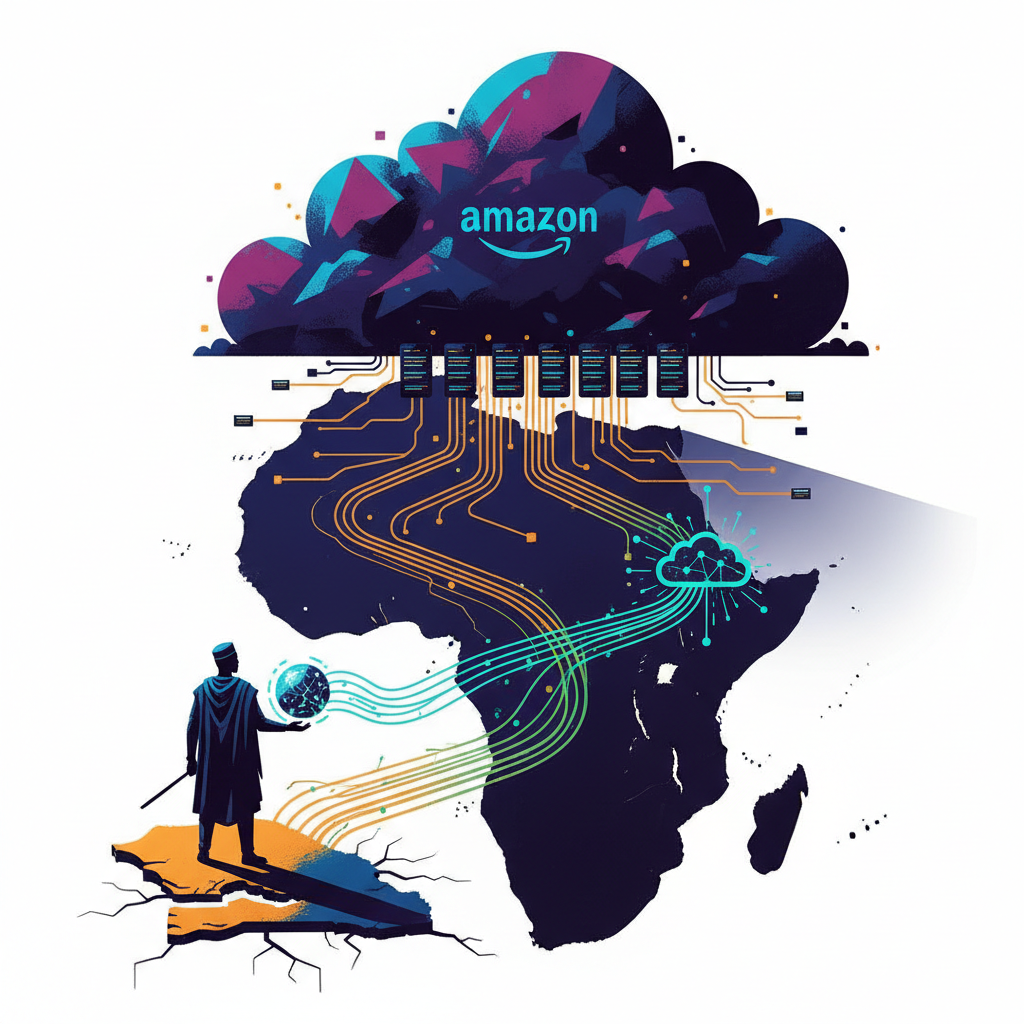

The digital landscape of Africa, a continent often viewed as the next frontier for technological expansion, is currently undergoing a silent, yet profound, transformation. At its heart lies the formidable shadow of Amazon Web Services, specifically its AI service, Bedrock. While presented as an accelerator for innovation, my sources tell me that this platform, designed to simplify access to foundational models, carries with it a significant risk: the potential for a new form of digital colonialism, particularly for nations like Senegal.
The Risk Scenario: A Single Point of Failure, A Single Point of Control
The allure of AWS Bedrock is undeniable for enterprises seeking to integrate artificial intelligence without the prohibitive costs and complexities of building infrastructure from scratch. It offers a managed service that provides access to a suite of foundational models, both Amazon's own and those from partners like Anthropic and AI21 Labs. For a developing nation, the promise of readily available, powerful AI tools can seem like a shortcut to progress, a way to leapfrog traditional development hurdles. However, this convenience masks a deeper vulnerability: the consolidation of critical AI infrastructure under a single, foreign entity. If a significant portion of Senegal's public and private sector AI applications become reliant on Bedrock, any disruption, policy change, or pricing shift by Amazon could have cascading, potentially crippling, effects on our economy and national security. This is not merely a hypothetical concern, but a strategic risk that demands immediate scrutiny.
Technical Explanation: The Bedrock Architecture and Its Implications
AWS Bedrock operates by abstracting away the complexities of deploying and managing large language models and other generative AI capabilities. Customers can choose from various foundational models, fine-tune them with their own data, and deploy them via an API. This means that the computational power, the model weights, and often the inference processes themselves reside within Amazon's global data centers. While data can be kept private and not used for further model training, the reliance on Amazon's proprietary infrastructure for processing and serving these models is absolute. For a Senegalese startup or government agency, this means that their intellectual property, their sensitive data, and their operational continuity are inextricably linked to a service governed by foreign laws and corporate policies. The technical architecture, while robust, inherently centralizes control. It is a powerful engine, but one whose ignition key remains firmly in Seattle.
Expert Debate: Innovation versus Sovereignty
The debate surrounding platforms like Bedrock often pits the undeniable benefits of rapid innovation against the imperative of digital sovereignty. "The speed at which AWS allows African companies to deploy advanced AI is unprecedented," states Dr. Aisha Traoré, a leading AI researcher at the Cheikh Anta Diop University in Dakar. "Without such platforms, many of our startups would struggle to compete globally, let alone locally. The cost of building and maintaining custom AI infrastructure is simply too high for most." Her perspective highlights the pragmatic need for accessible technology to foster economic growth and technological advancement.
However, others voice profound caution. Professor Jean-Luc Dubois, an expert in digital governance from the African Institute for Mathematical Sciences, offers a stark warning. "While the immediate gains are attractive, we must consider the long-term implications. When our critical infrastructure, our data, and our intelligence systems are hosted on foreign soil, we cede control over our digital destiny. We risk becoming mere consumers of technology, rather than creators and owners. This is not true development, it is a sophisticated form of dependence." His concerns resonate deeply with the historical context of economic exploitation that has plagued many African nations.
Furthermore, regulatory bodies globally are grappling with these issues. The European Union's AI Act, for instance, seeks to impose strict regulations on high-risk AI systems, including those deployed via cloud providers. While Africa has yet to develop a unified regulatory framework of this magnitude, the discussions are gaining momentum within regional blocs like Ecowas. The question remains: how will these regulations interact with the global reach of cloud giants like Amazon, and who will ultimately hold the reins of power?
Real-World Implications for Senegal
For Senegal, the implications of a deep reliance on platforms like AWS Bedrock are multifaceted. Consider the burgeoning fintech sector, a vital engine of our economy. If financial institutions process sensitive customer data and perform fraud detection using AI models hosted on Bedrock, any outage or security breach within Amazon's system could destabilize our financial markets. Similarly, in healthcare, where AI is increasingly used for diagnostics and patient management, the privacy and security of patient data become paramount. The documents reveal that several government initiatives, particularly in smart city development and agricultural optimization, are exploring or already utilizing cloud-based AI services. While efficiency gains are reported, the long-term strategic implications are often overlooked in the rush for modernization.
Our vibrant startup ecosystem, a source of immense pride and innovation, could also find itself in a precarious position. While Bedrock offers a low barrier to entry, it also creates vendor lock-in. Migrating complex AI workloads from one cloud provider to another is a monumental task, often prohibitively expensive and time-consuming. This effectively stifles competition and reduces the agility of our local tech companies. The dream of a truly independent, African-led digital future could slowly erode, replaced by an ecosystem tethered to the whims of a handful of global tech behemoths.
What Should Be Done: Charting a Sovereign Path
To mitigate these risks, Senegal and other African nations must adopt a proactive and strategic approach. Firstly, there must be a concerted effort to invest in local digital infrastructure, including data centers and high-performance computing capabilities. This does not mean shunning global cloud providers entirely, but rather creating a hybrid environment where critical data and strategic AI workloads can be hosted domestically. This approach aligns with the growing global trend towards data sovereignty and digital autonomy, as seen in nations like Germany and France.
Secondly, robust regulatory frameworks are essential. We need clear guidelines on data governance, AI ethics, and vendor accountability. These regulations must be developed with an understanding of both global best practices and local contexts, ensuring that they protect our citizens and foster fair competition. Collaboration within Ecowas and the African Union could lead to a harmonized approach, strengthening the continent's negotiating position with global tech giants.
Thirdly, and perhaps most crucially, we must invest in human capital. Developing a strong pool of local AI engineers, data scientists, and cybersecurity experts is paramount. This includes supporting local universities, vocational training programs, and research initiatives. The goal is not just to consume AI, but to build, innovate, and adapt it to our unique challenges and opportunities. This will empower us to develop our own foundational models, tailored to African languages, cultures, and data sets, rather than relying solely on models trained on Western data. MIT Technology Review has often highlighted the importance of localized AI development for true societal impact.
Finally, fostering open source AI initiatives can provide a vital alternative to proprietary platforms. By contributing to and leveraging open source models, African developers can reduce reliance on single vendors and promote collaborative innovation. Organizations like Hugging Face, for example, demonstrate the power of community-driven AI development. TechCrunch frequently covers the impact of open source on the broader AI ecosystem.
The path forward is not to reject the advancements offered by companies like Amazon, but to engage with them on our own terms. Senegal, with its rich history of resilience and self-determination, must ensure that its digital future is built on foundations of sovereignty and strategic independence, not on the shifting sands of corporate control. This is just the tip of the iceberg, and the vigilance required will be continuous and unwavering. Our digital destiny, much like our political one, must remain firmly in our own hands.