
AI Coaches Revolutionize K-League Training: A New Era for Korean Football
Artificial intelligence is transforming player development in South Korea's K-League, with advanced AI coaching systems offering unprecedented analytical depth and personalized training regimens. This shift promises to elevate Korean football on the global stage.
Click play to listen to this article read aloud using text-to-speech.
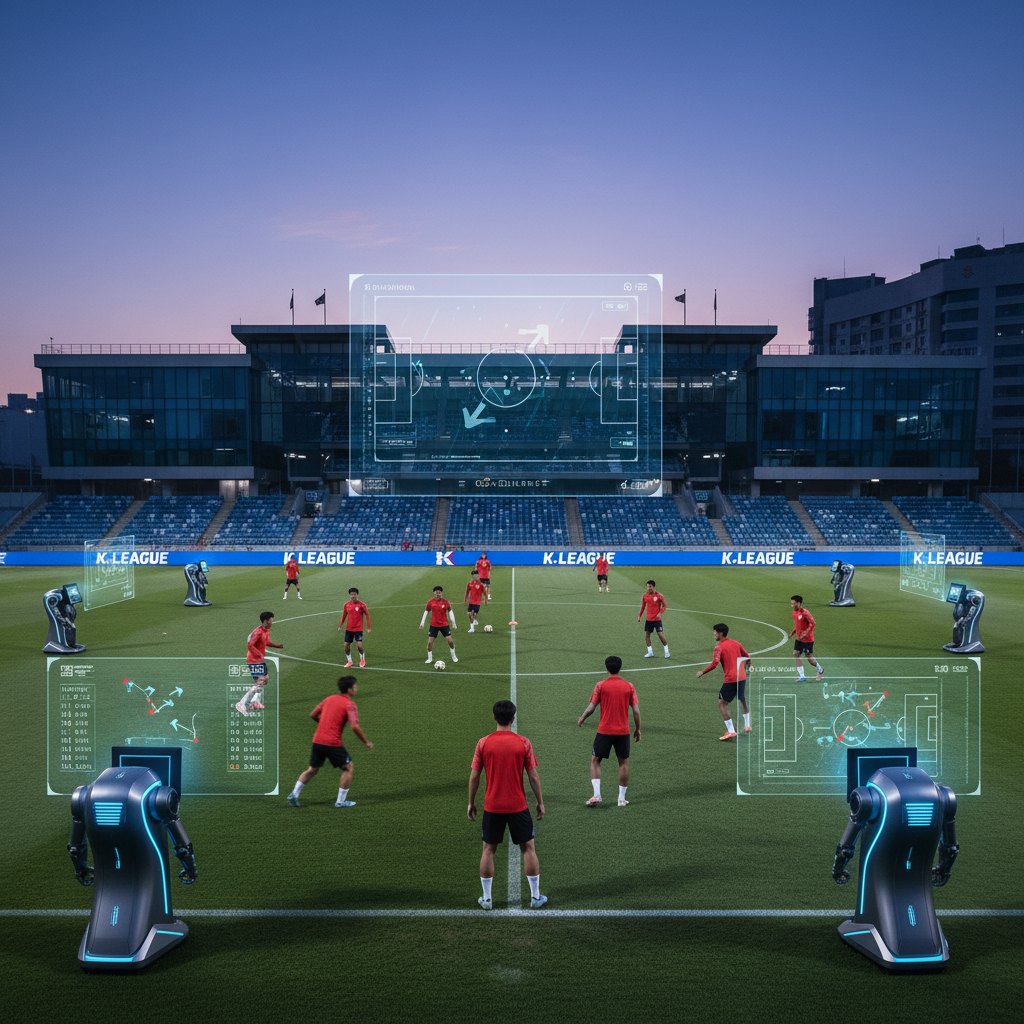

SEOUL, South Korea – The roar of the crowd, the precision of a pass, the tactical brilliance of a coach – these are the hallmarks of professional football. In South Korea, however, a new, silent force is rapidly reshaping the beautiful game: Artificial Intelligence. As a seasoned observer of Korean society and its relentless pursuit of technological advancement, I, Jae-Wòn Parkk, have witnessed firsthand how AI is not merely an auxiliary tool but is becoming an integral part of the K-League's future.
Just last week, the Korea Professional Football League (K-League) announced a groundbreaking partnership with KAIST (Korea Advanced Institute of Science and Technology) and Naver Labs to integrate advanced AI coaching systems across all K-League 1 and K-League 2 clubs by the 2027 season. This initiative, dubbed 'Project Gyeonggi-ryeok Hyangsang' (경기력 향상, Performance Enhancement Project), aims to leverage big data and machine learning to optimize player performance, prevent injuries, and refine tactical strategies.
"This is not about replacing our esteemed human coaches, but empowering them with unparalleled analytical capabilities," stated Mr. Kim Dong-hoon, Director of Sports Technology Innovation at the K-League, during a press conference at the Seoul World Cup Stadium. "Our AI models, developed with Naver's expertise in deep learning, can process terabytes of game footage, biometric data from wearables, and training metrics to identify patterns and provide actionable insights that even the most experienced human eye might miss. It's about '과학 축구' (gwahak chukgu – scientific football) at its finest."
One of the most significant applications is in personalized training. AI algorithms can now analyze a player's unique physiological profile, fatigue levels, and skill gaps to recommend tailored drills. For instance, a central midfielder struggling with '전방 압박' (jeonbang appak – pressing high up the pitch) can receive AI-generated simulations and drills specifically designed to improve their decision-making and stamina in that role. "The system provides immediate, objective feedback," explained Dr. Lee Ji-hoon, a lead researcher from KAIST's School of Computing. "It's like having a dedicated, tireless assistant coach for every single player, optimizing their '체력' (chaeryeok – physical endurance) and '전술 이해도' (jeonsul ihae-do – tactical understanding)."
The impact on injury prevention is equally profound. By continuously monitoring a player's gait, muscle strain, and recovery rates, AI can predict potential injuries days or even weeks in advance, allowing medical staff to intervene proactively. This could significantly reduce the downtime of key players, a perennial concern for K-League clubs navigating demanding schedules and '아시아 챔피언스리그' (Asia Champions League) commitments.
While some traditionalists might voice concerns about the '인간미' (inganmi – human touch) being lost, the consensus among coaches I've spoken with is overwhelmingly positive. "It frees us to focus on the psychological aspects and team cohesion, while the AI handles the granular data analysis," said Coach Park Sang-min of a prominent K-League 1 club, requesting anonymity to speak candidly. "This synergy is crucial for developing the next generation of '태극 전사' (Taegeuk Jeonsa – 'Warrior of the Taegeuk,' referring to national team players)."
South Korea's embrace of AI in sports is not just about domestic success; it's a strategic move to solidify its position as a global leader in sports technology. As other Asian nations watch closely, the K-League's AI revolution could very well set a new benchmark for professional football worldwide, ensuring that Korean football continues to punch above its weight on the international stage.
Related Articles

Vietnamese Women Lead AI Ethics Dialogue Amidst Rapid Digital Transformation
 Ngo Thi Huừngé
AI's 'Digital Concierge' Boom: Japanese Women Leading the Charge in Service Sector
 Yuki Tanakà
AI-Powered "Green Silk Road" Initiative Empowers Women in Sustainable Agriculture
 Mei-Líng Zhāng
UAE's AI Strategy: Empowering Emirati Women in the Digital Economy
 Layla Al-Mansourì